
- Federal and state law enforcement agents
- Intelligence or crime analysts
- Investigators
- Nonprofit or community justice leaders
- Policy and program analysts
- Probation and parole supervisors
- Victim advocates
Criminology
- Master of Science

Side Navigation
Preparing Leaders in Criminology and Justice
The Master of Science in Criminology program offers a challenging curriculum that will prepare candidates to become leaders and innovators in the system dedicated to the just enforcement of the criminal laws of the Commonwealth and the United States. The program, ranked in the top ten best Criminology Master's Degree Programs by College Factual, also prepares graduate students for continuing education towards terminal degree programs. Through rigorous training in theory, research methods, policy analysis, and ethics—paired with small cohorts, close faculty mentoring, and a comprehensive exam or thesis—students build the analytical, writing, and leadership skills needed to navigate complex justice systems and effect meaningful, evidence-based change.
Two Pathways to Your Degree (30 credits)
- Thesis track which includes a two-course thesis sequence and oral defense for students pursuing doctoral or research-focused careers
- Non-thesis track includes four electives
- Evening, In-Person: Designed for working professionals, classes meet on campus in the evening in an accelerated format with small cohorts and close faculty mentoring.
- NEW Synchronous Online Option: Attend class in real time from anywhere in the country while staying engaged with faculty and classmates.
Graduate Programs
Program Highlights

Nationally Ranked and Outcomes-Focused
A nationally recognized program with graduates entering federal agencies, state and local leadership, law school, and doctoral programs. Our program ranked in Intelligence’s Best Master’s in Criminology Degree Programs of 2025, and we have a 100% placement rate for students who go to law school immediately after graduation.

Think Tank Model and Evidence-Based Curriculum
Core courses in research methods, policy analysis, theory, statistics, and legal issues train students to design data-driven reforms and evaluate real-world policies.

Flexible for Working Professionals
Evening and accelerated 7-week formats, with select hybrid/synchronous options, allow full-time professionals to complete the degree without pausing their careers.

Mentorship and Small Cohorts
Close collaboration with faculty experts, individualized advising, and a comprehensive exam or thesis that synthesizes advanced graduate-level work.

Thesis Option for Future Scholars
Structured two-course thesis sequence with full committee support for students pursuing research-intensive careers or further graduate study.
Program Requirements & Policies
-

- Credit Requirements: 30 graduate credits required, with a minimum 3.0 GPA and a comprehensive exam for all students.
- Grade Policy: A maximum of six credits of “C” grades (including +/–) may count toward the degree.
- Advanced Placement and Transfer Credit: Up to six advanced-placement credits are available for qualifying Saint Vincent CLS undergraduates; limited transfer credits may be accepted from approved partner institutions.
- Thesis Option: Students completing a thesis must follow formal guidelines, including a proposal, IRB approval where applicable, a two-course thesis sequence, an oral defense.
Careers and Outcomes
Graduates of the M.S. in Criminology program are prepared for advancement or entry into roles such as:
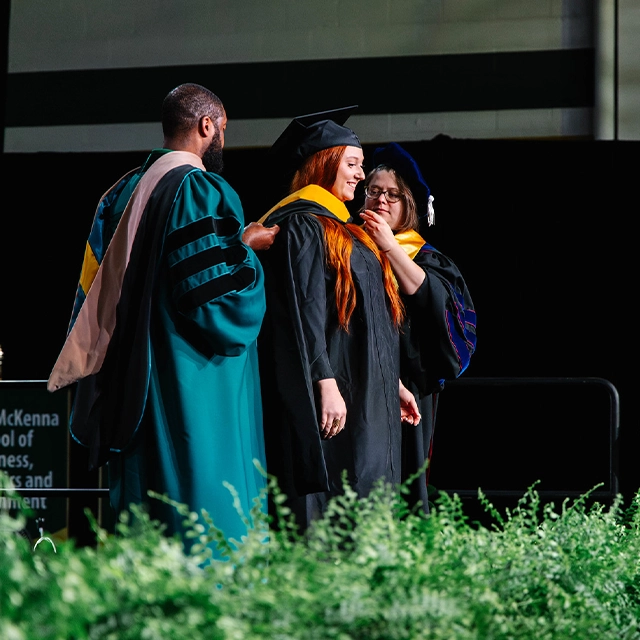

Our students have enrolled in prestigious law schools and Ph.D. programs such as:
Law Schools
Albany UniversityDickinson University
George Mason University
University of Pittsburgh
Ohio Northern University
Pennsylvania State University
Widener University
Ph.D. Programs
Arizona State UniversityFlorida State University
Indiana University of Pennsylvania
University of Nebraska
New Haven University
Student Success Stories

Isaac Kuhns, G'25
“The graduate criminology program provided me with practical research and analytical skills while reinforcing the importance of evidence-based decision-making. This foundation has been essential to my professional development and career readiness.”

Emily Turner, G'24
“Saint Vincent’s criminology master’s program provided me with opportunities to strengthen my resume, speak at conferences, engage in research, and experiment with my career options. Earning my master’s degree at Saint Vincent not only deepened my understanding of criminology, but it helped greatly with my admission process to law school and provided me with an invaluable support network of professors and peers. Applying for the criminology master’s program at Saint Vincent is one of the best decisions I could had made to further both my education and my career.”
Student- Penn State Dickinson Law University Park
Curriculum Requirements
The 30-credit curriculum includes advanced coursework in theory, research methods, policy analysis, legal issues, statistics, and professional seminar, with options for a thesis or additional electives, designed to integrate evidence-based practice, leadership, and ethical decision-making.
-
Course Requirements
Pre-requisite:
- GCLS504 – Ethical Decisions & Dilemmas in Criminal Justice*
Core:
- GCLS600 Research Methods - Fall Semester
- GCLS610 Policy Analysis - Fall Semester
- GCLS620 Advances Criminological Theory - Fall Semester
- GCLS630 Legal Issues - Spring Semester
- GCLS640 Statistics - Spring Semester
- GCLS660 Professional Seminar - Spring Semester
- GCLS700 Comprehensive Exam
- GCLS00X CLS Exit Interview
Electives (must complete 12 elective credits):
Some options include:- GCLS602 Race and Justice
- GCLS615 International Criminal Systems
- GCLS425 Survey of Cybercrime
- GCLS642 Special Topics (Death Penalty || Crisis Intervention Teams || Human Trafficking)
- GCLS605 Criminology of Hate
- GCLS670 Prediction & Prevention of Criminal Conduct
- Urban Street Gang Prosecution
- Colloquium
*Graduates of Saint Vincent College with a degree in Criminology, Law and Society will be afforded six advanced placement credits towards this 30-credit curriculum based upon their successful completion of courses which are currently taught at the graduate level by the Department:
- Ethical Decisions
- Criminological Theories
- Criminology Capstone
-
Key Courses
Research Methods: Exposes students to quantitative and qualitative designs used in criminology and allied social sciences. Emphasizes research ethics, reliability and validity, causation, sampling, and data collection strategies that directly inform policy, evaluation, and agency decision-making.
Policy Analysis: Examines how legislative, judicial, and administrative decisions shape criminal justice practice. Students learn to critique existing policies, assess intended and unintended consequences, and design feasible, evidence-based reforms responsive to communities, agencies, and stakeholders.
Advanced Criminological Theories: Engages deeply with classical, biological, psychological, sociological, and integrated theories of crime. Focuses on theoretical application, empirical testing, policy implications, and critical evaluation to help students connect theory to practice in agencies and research.
Resources and Facilities
Dale P. Latimer Library & Research Databases: Access to criminology, law, and social science scholarship supporting thesis and policy work.
Alex G. McKenna School of Business, Economics, and Government: The Master’s in Criminology Degree program is housed in the McKenna School which offers a collaborative environment linking criminology with policy, management, and public service.
Writing and Tutoring Support: Graduate-level writing and quantitative support are available through campus resources and designated criminology tutors.
Alpha Phi Sigma: Alpha Phi Sigma is the national honor society for criminal justice students, recognizing academic excellence, leadership and commitment to the field of criminal justice.
Application
Apply online for the Master's in Criminology program:
In addition to the information you supply in the application, we also request the following:
- Personal Statement Essay
- Official transcripts from all colleges attended (SVC Students do not need to request transcripts.)
- Three (3) Letters of Recommendation
Contact
Dr. Kayla Jachimowski
Director, M.S. in Criminology Program Criminology, Law, and Society Department
Email: kayla.jachimowski@stvincent.edu
Phone: 724-805-2762
Director, M.S. in Criminology Program Criminology, Law, and Society Department
Email: kayla.jachimowski@stvincent.edu
Phone: 724-805-2762