Environmental Science

  • Bachelor of Science
  • Minor

A Multidisciplinary Path to Solving Global Challenges

The environmental science program provides students with a strong foundation in scientific principles, equipping them to understand and address complex environmental challenges. Rooted in the liberal arts, the program emphasizes a multidisciplinary approach, combining rigorous scientific investigation with insights from social, political, and ethical perspectives. We believe that environmental problems are best solved through this integrated lens, preparing students to think critically and act responsibly in a rapidly changing world. You will build a strong foundation in the natural sciences, apply your skills through scientific investigations in wildlife biology and environmental chemistry, and broaden your perspective in courses such as Environmental Literature and Green Discipleship. By choosing a minor or specific electives, you can design a program that aligns with your career goals. As a result, you will be prepared to pursue a variety of careers in the environmental field.

Undergraduate Programs

Program Highlights

Careers and Outcomes

Environmental science students are prepared for careers in the environmental field such as environmental monitoring or testing, environmental communication, watershed management or environmental education. Students can also pursue graduate programs in environmental science, environmental law, or education.

Alumni will go on to successful careers as:

  • Air Quality Specialists
  • Climate Change Analysts
  • Conservation Scientists
  • Environmental Consultants
  • Environmental Educators
  • Environmental Engineers
  • Hydrologists
  • Marine Biologists
  • Freshwater Biologists
  • Sustainability Coordinators
  • Wildlife Biologists

Our students have secured jobs and internships at a variety of companies in their field and enrolled in prestigious graduate schools such as:

  • Allegheny County Health Department
  • Allegheny Land Trust
  • Army Corps of Engineers
  • Indiana County Conservation District
  • Moody & Associates
  • Pennsylvania Fish and Boat Commission
  • Stream Restoration Incorporated
  • United States Geologic Survey
  • Waste Strategies
  • Westmoreland Conservation District
  • Duquesne University
  • Johns Hopkins University
  • University of Illinois

Student Spotlight

Smiling person in a dark green shirt standing in front of a window with buildings and trees in the background.

Stephen Laun C’26

“Through the environmental science department's faculty at Saint Vincent College, I was able to discover my major and further my interests in exciting and enjoyable ways. Dr. Smyntek, along with the rest of the environmental science related faculty are some of the most caring and welcoming individuals I have met.”

Curriculum Requirements

The environmental science major is part of The Herbert W. Boyer School of Natural Sciences, Mathematics and Computing and supported by our core curriculum, where students delve into diverse academic subjects at both foundational and advanced levels to explore how different disciplines connect, fostering deeper self-understanding and proficiency in their chosen field of study.

  • Requirements for a Bachelor of Science Degree in Environmental Science

    Environmental Science Major Requirements (69-76 credits):

    ES 100 Nature & Sustainable Resources 3

    ES 150,152 Earth Systems Science and Lab 4

    ES 220 Introduction to Geographic Information Systems 3

    ES 300 Research Seminar I 2

    ES 301 Research Laboratory 2

    ES 302 Research Seminar II 1

    ES 550 Environmental Science Internship 0-3

    EL 111 Environmental Literature 3

    PS 390 Environmental Law and Policy 3

    SO 161 Foundations of Sustainability 3

    BL 150-153 General Biology I and II and Labs 8

    BL 232, 233 Ecology and Lab 4

    CH 101-104 General Chemistry I and II and Labs 8

    CH 216, 218 Quantitative Analysis and Lab 4

    PH 109, 113 College Physics I and Lab 4

    Math Requirement: 8-1

    MA 102, MA 103 Calculus 1 with Review A &B and MA-110 and Calculus with Applications II
    or
    MA 109-110 Calculus with Applications I and II
    or
    MA 111-112 Analytical Calculus I and II

    Humanities: Choose at least one

    HI 226 Society and the Environment: The American Experience

    PL 217 Environmental Ethics

    PL 219 Ethics and Technology

    TH 274 Green Discipleship

    Advanced Environmental Courses: Choose 1 course with Lab if available (3-4 credits)

    BL 228, 229 Wildlife Biology and Lab

    BL 230, 231 Ornithology and Lab

    BL 240,241 Conservation Biology and Lab

    BL 252,253 Invertebrate Zoology and Lab

    Physical Environmental Science: Choose 1 course with Lab (3-4 credits)

    ES 245, 246 Hydrology and Limnology and Lab

    ES 230 Energy and the Environment

    CH 276, 277 Advanced Environmental Chemistry and Methods of Environmental Analysis

    ES 250 Advanced Environmental Mapping

    Environmental Science Minor Requirements (15-17 credits) ***

    Required (6 courses/ 12 credits):

    ES 150,152 Earth Systems Science and Lab 4

    BL 232,233 Ecology and Lab*** 4

    CH 216,218 Quantitative Analysis and Lab*** 4

    Choose one course with lab if available: (May not count toward major)

    CH 276 Advanced Environmental Chemistry*** 3

    CH 277 Methods of Environmental Analysis (Lab)*** 2

    CH 228,229 Wildlife Biology and Lab*** 4

    BL 230, 231 Ornithology and Lab*** 4

    BL 240, 241 Conservation Biology and Lab*** 4

    ES 230 Energy and the Environment*** 4

    ES 240 Geophysics*** 3

    ES 245, 246 Hydrology and Limnology and Lab 4

    ES 250 Advanced Environmental Mapping 3

    BL 252,253 Invertebrate Zoology and Lab 4 ***

    ***General Chemistry I and II and/or General Biology I and II are prerequisites for these courses.

  • Key Courses

    Nature and Sustainable Resources You will learn key concepts and skills that naturalists and environmental scientists use to understand the natural world and our impact on it. It covers aspects of geology, hydrology, atmospheric science, and ecology, with a focus on understanding sustainable approaches to use and manage natural resources in a way that reduces impacts on the natural environment and local communities.

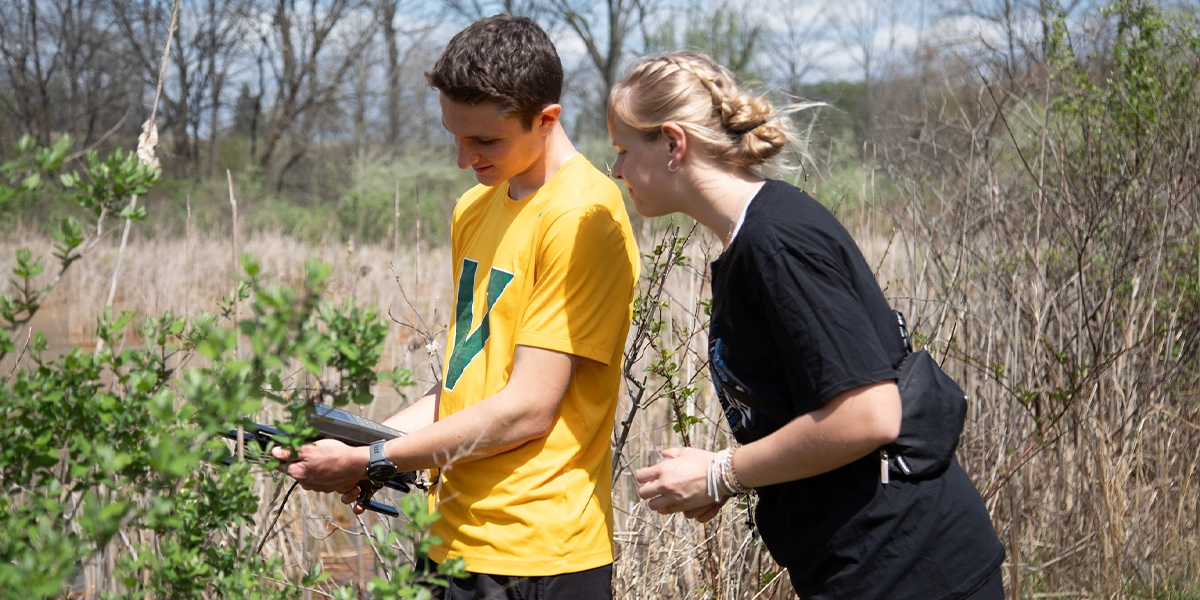
    Hydrology And Limnology Lab You will learn how to measure and model physical and biogeochemical characteristics of stream and lake ecosystems by using instruments and data analysis tools to examine water velocity, discharge, mixing, chemical composition and related parameters that define these dynamic ecosystems. Field sampling, laboratory experiments and computer modeling and simulations will be used to assess a variety of stream and lake systems.

    Wildlife Biology This course combines elements of animal natural history, physiology, and behavior to survey how animals cope with short-term and seasonal changes in their environment. You will learn about the challenges animals face in maintaining homeostasis during periods of reproduction, migration, hibernation, resource scarcity, and predation risk.

Resources and Facilities

Undergraduate Programs