Alumni will go onto successful careers as
- Auditors
- Business consultants
- Financial analysts
- Government institution accountants
- Private company accountants
- Public company accountants
- Tax associates

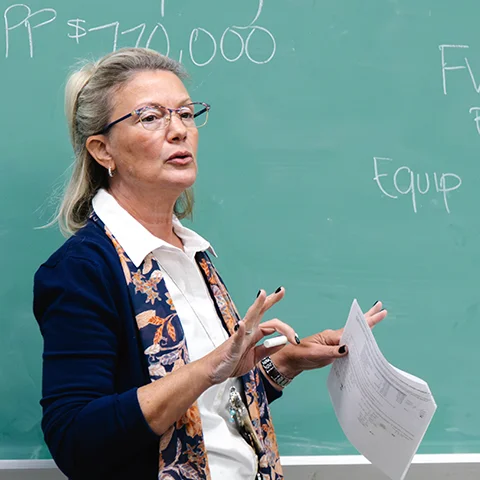
Saint Vincent College offers a comprehensive accounting program designed to give students a strong foundation in both accounting and business. In your courses, you will work on case studies, research key topics, deliver professional presentations, and examine real-world business challenges. The program helps future business professionals understand how different parts of an organization connect and operate. You can also choose to complete an accounting internship for college credit, gaining practical experience that complements classroom learning. The curriculum emphasizes technology in accounting and explores ethical considerations that shape the profession. By graduation, you will have a well-rounded education that combines accounting with finance, marketing, and management, preparing you for success in a variety of business roles.

As an SVC accounting major, you will be well- prepared to take the Certified Public Accountant Examination. Recent graduates of our accounting program have achieved some of the highest first-time CPA exam pass rates in the country, placing Saint Vincent College in the top 5% nationally.

Graduating with a degree in accounting sets you up for success. Accounting has been ranked fifth among all majors for demand in the next decade, with jobs for accountants and auditors having a projected 6% growth rate, according to the Bureau of Labor Statistics. SVC Accounting graduates have a 98% job or graduate school placement in accounting-related positions, with an average starting salary of over $63,000.

You will have multiple opportunities to make an impact on businesses who are hiring. Numerous accounting firms attend our Campus Interview Day, interviewing our students for positions in internships or full-time careers. Students also participate in the Accounting and Finance Consortium, connecting accounting and finance students from faith-based colleges with leaders in business and industry.
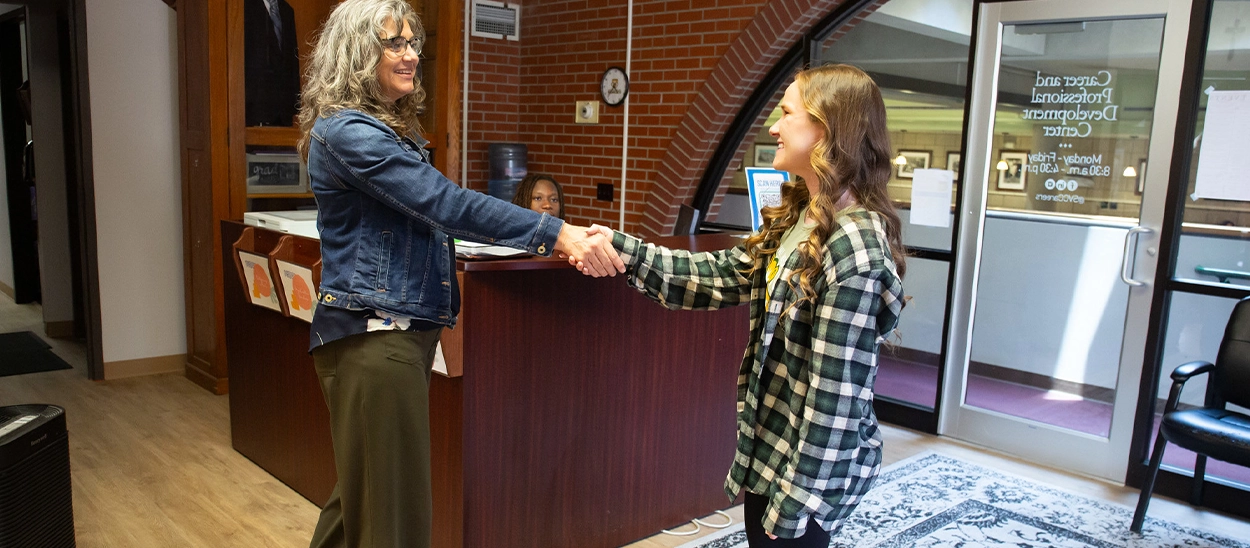
You will be encouraged to work with the Career and Professional Development Center to acquire an internship giving you real-world experience. Often these internships lead to full-time positions with local firms.

This club offers a variety of opportunities to supplement your regular classroom learning with accounting lectures presented by accounting firms and businesses, networking opportunities with alumni and industry experts, and visits to corporate headquarters.
The accounting field offers diverse career paths, including corporate and forensic auditing, tax services for businesses and individuals, and roles within corporations, nonprofits, and government agencies. Saint Vincent prepares students for successful and meaningful careers in organizations that need skilled accounting professionals.
Alumni will go onto successful careers as
Our students have secured jobs and internships at a variety of companies in their field such as:
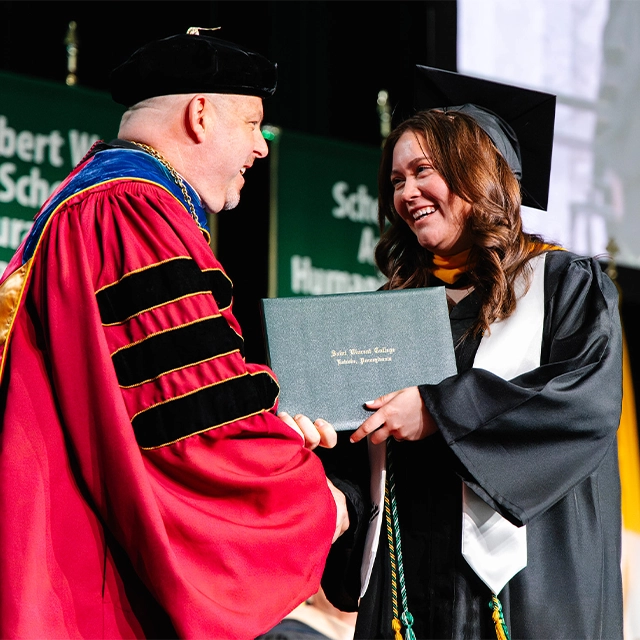

“I chose Saint Vincent College because of its nationally recognized McKenna School of Business, known for its knowledgeable accounting faculty and rigorous, hands-on coursework. This program has an emphasis on real-world applications, in areas such as financial analysis and auditing, gives me the tools to connect what I learn in the classroom directly to my future in public accounting. I am confident that this combination of expert instruction and practical experience will prepare me to excel on the CPA exam and in the field.”

"I chose Saint Vincent because I found professors who genuinely care. From day one, the professors took the time to get to know me—not just as a student, but as a person, always willing to help, whether it’s related to class or not. The Accounting Department prepared me to succeed both in the classroom and in real-world settings. With a solid foundation in financial and intermediate accounting, I entered my internships confident in my skills—and that helped me stand out. The Saint Vincent Community has also been instrumental with networking for internships and full-time jobs. It's rare to find a place where professors care this much—and I'm grateful I did."
Schneider Downs

"Saint Vincent was an easy choice for me, as I had various family members graduate with an accounting degree from the College. Seeing their successes inspired me to join the Bearcat family as an accounting major. I knew I would be challenged from day one, which is exactly what I was looking for in my education. The professors do a wonderful job of teaching difficult content and are always willing to adapt their instruction to best fit the learning needs of students. I can confidently say that my Saint Vincent education has prepared me to sit for and pass sections of the CPA exam, as well as transition into a career with endless opportunities.”
The accounting major is part of the Alex G. McKenna School of Business, Economics, and Government and supported by our core curriculum, where students delve into diverse academic subjects at both foundational and advanced levels to explore how different disciplines connect, fostering deeper self-understanding and proficiency in their chosen field of study.
All accounting majors must take College and Business Core Classes.
Business Core (44 credits)
BA 100 Financial Accounting I (freshman year)
BA 170 Organizational Behavior (freshman year)
BA 220 Principles of Marketing (2nd semester freshman year)
BA 265 Management Information Systems (sophomore year)
BA 305 Business Ethics (junior year preferred)
BA 320 Corporate Finance I (sophomore year)
BA 340 Business Law (junior year)
BA 350 Statistics I and BA 350A Excel Lab (sophomore year)
BA 351 Statistics II and BA 351A Excel Lab or EC 360 Econometrics and EC 361 Lab (sophomore year)
BA 495 Business Policy and Strategy (senior year)
EC 101 Principles of Microeconomics (freshman year)
EC 102 Principles of Macroeconomics (freshman year)
PS 100 Principles of American Politics
MA 109/111 Calculus I (freshman year)
BA 00P ePortfolio Requirement (semester of graduation--pass/fail)
Accounting Major Requirements (27 credits)**
BA 101 Financial Accounting II (freshman year)
BA 200 Intermediate Accounting I
BA 201 Intermediate Accounting II
BA 300 Cost Accounting I
BA 310 Taxes I
BA 405 Auditing
BA 470 International Accounting
Choose two courses from the following:
BA 301 Cost Accounting II
BA 311 Taxes II
BA 325 Analysis of Financial Statements
BA 400 Advanced Accounting
BA 406 Forensic Auditing
BA 420 Accounting Information Systems
BA 440 Government and Not-for-Profit Accounting
Additional courses
BA 304 SAP Financial and Accounting Applications
BA 312 Tax Lab
**Total credits required for the business administration accounting major is 70 credits. After completing this major and the college core, you will have 6 credits for electives.
Accounting Minor: Required Courses
BA 100 Financial Accounting I
BA 101 Financial Accounting II
BA 200 Intermediate Accounting I
BA 201 Intermediate Accounting II
In addition to the above, choose any two of the following:
BA 150 Managerial Accounting - 3 credits or BA 300 Cost Accounting I
BA 301 Cost Accounting II
BA 310 Taxes I
BA 311 Taxes II
BA 325 Analysis of Financial Statements (Corporate Finance majors may not count this course)
BA 400 Advanced Accounting
BA 405 Auditing
BA 406 Forensics Auditing
BA 420 Accounting Information Systems
BA 440 Government and Not-For-Profit Accounting
BA 470 International Accounting
Students studying accounting will develop critical accounting skills and be able to apply accounting knowledge to a multitude of business situations. They will learn to interpret financial statements and ratios used to make business decisions. Accounting students will take courses such as:
Intermediate Accounting I and II: This course offers an in-depth exploration of key accounting topics, including income statements, balance sheets, cash flow, inventories, fixed and intangible assets, liabilities, investments, leases, and stockholders' equity. You'll also dive into error corrections and other advanced subjects—all building on the strong foundation established in Financial Accounting I and II.
Advanced Accounting: Explore the complexities of financial reporting in this advanced course, which covers income presentation, interim reporting, and segmental data disclosure. You'll also delve into business combinations and consolidated financial statements, partnership changes and liquidation, as well as specialized areas like governmental and nonprofit accounting.
International Accounting: Gain a global perspective on accounting practices as you examine how financial reporting varies across countries. This course covers international accounting standards, challenges faced by multinational corporations, and the translation of foreign financial statements under U.S. GAAP—equipping you with the knowledge to navigate the international business landscape.
 The McKenna School of Business has eight undergraduate programs and one graduate program accredited by the Accreditation Council for Business Schools and Programs (ACBSP). They are accounting, business administration, business data analytics, business economics, finance, international business, management, marketing, sports management, and the Master of Science in management: operational excellence graduate program.
With a requirement for faculty professional development (e.g., publications and research) and courses primarily taught by faculty holding doctorates, the ACBSP is the leading business accreditation program devoted to teaching excellence and service to students.
The McKenna School is also a member of the Middle Atlantic Association of Colleges of Business Administration.