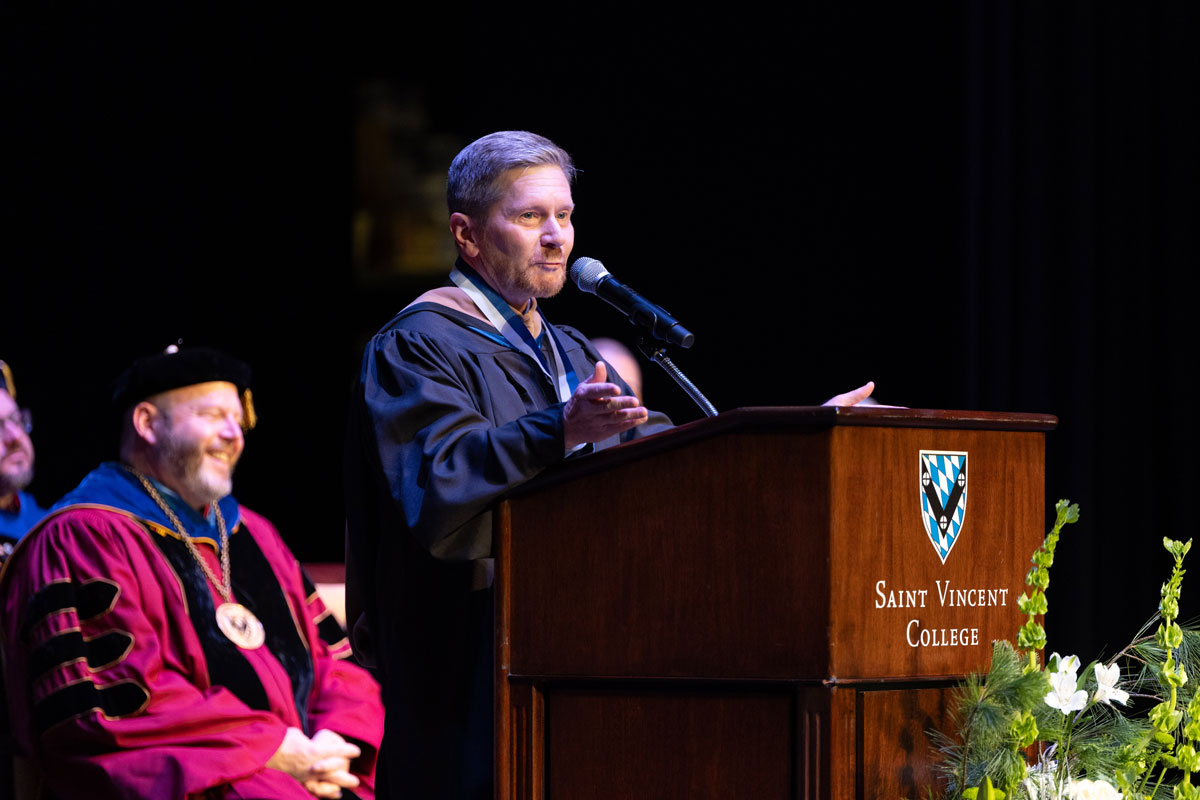
LATROBE, PA – Michael Keslar, C’80, divisional chief information officer for the Bank of New York Mellon Corp. (BNY), president of BNY Pennsylvania and Saint Vincent College Board of Directors member, delivered the address at the College’s 21st annual Winter Commencement on Saturday, Dec. 13, in the Performing Arts Center, located within the Robert S. Carey Student Center.
Rev. Paul Taylor, O.S.B., C’87, S’91, PhD, president of the College, presented Keslar with the Presidential Medal of Honor, which is awarded for extraordinary service and leadership to profession, community, family, church or education.
Keslar’s Commencement address focused on artificial intelligence in the world today and how we can use it to our benefit as well as on the personal relationships that he has developed and maintained at Saint Vincent College.
“Let's talk about unexpected pivots, old BMWs, the impact of AI and, most importantly, the power of the values that you and I both learned on this campus,” Keslar said to the graduates. “My time at Saint Vincent was great. I was a pretty good student. I did okay, but I worked very hard.”
He said he spent seven days a week in the library, a facility that now looks quite different compared to Keslar’s time on campus as a college student.
“I also didn't have the advantage of an iPhone, a PC, or obviously no artificial intelligence,” Keslar noted. “What I had, though, was help from humans, old fashioned ways. People helped me through school.”
For example, in Keslar’s “early days in the yellow stacks of the library,” he met an upperclassman who took the young student under his wing and became a lifelong mentor.
“I'm proud to say that person has stayed involved in my life, been a mentor all through my career, not just Saint Vincent, not just through Pitt, all the way through all my career moves,” Keslar said. “This person has been there to advise me and help me, and I've been very grateful that I met him here on campus.”
“The lesson here,” Keslar added, “is embrace your relationships, both your family and your friends, and ask for help on your continued journey. And accept even unexpected help whenever it presents itself and continue to build your network as you move forward.”
He called his career at BNY unconventional, starting in a business role before moving into engineering, where he eventually directed a group of 4,000 engineers. For the past three years, Keslar has been focused on artificial intelligence and its applications at BNY, which was formed in 2007 by the merger of Mellon Bank and the Bank of New York.
“The way to summarize what we do as a company is we manage money, we move money and we keep money safe,” Keslar said. “And to give you an illustration of scale, we process $2 trillion of payments every day, and we keep safe $50 trillion of assets. So, with that, we're known as the largest safekeeping bank or custody bank in the world.
“And we touch 20% of the world's investable assets on a daily basis. In essence, we’re the plumbing of the financial markets and we're critical to the health of the financial markets and their ability to operate every day.”
Technology is profoundly important to BNY, Keslar added, noting the company spends about $4 billion annually on technology.
“We're very aggressive in AI,” he said. “We've been adopting it for three years, and we have a mantra that comes from our CEO: ‘AI is for everyone, AI everywhere and AI for everything.’”
While BNY has excelled with artificial intelligence in business practices, Keslar encouraged the December 2025 graduates to use AI on a daily basis in their personal lives.
“You'd be surprised how many things it can do for you,” he said.
The Saint Vincent College alumnus shared a recent story of his 1987 BMW that he purchased shortly after graduation.
“I get a lot of kidding and ribbing from my coworkers. They know I make a decent salary; they want to know why I don't want to buy a new car, and it's just a thing with me,” Keslar said. “I am proud that I'm able to keep that car running. It's never broken down, and I've never had to have it towed.”
But about two months ago, Keslar was driving out of his neighborhood in Murrysville when the vehicle broke down.
“I drifted it to the side of the road and I thought, ‘This is a great place for me to use AI. It's going to help me figure out what went wrong,’” Keslar recalled. “So, I loaded the information just on my phone while I'm sitting in the car. Meanwhile, my neighbors are having fun driving past, asking me, ‘Hey, Mike, you need a tow? Mike, you need a jump?’ I said, ‘No, I have it covered.’
“So, I put in all the information, and the AI that I was using came back and told me that it recommended that I listen closely when I try to start the car, and see if I hear this straining sound in the back near the gas tank, and if that's the case, it's probably the fuel pump. So, sure enough, I did that, I listened, I heard the straining sign. I put in that information, and AI told me, ‘You're out of luck. You should get a tow.’”
As it was a Sunday night, Keslar didn’t bother to immediately contact a towing service and instead went home. After a while, he decided to try one last troubleshooting measure.
“I went to Walmart, I got a gas can, I got two gallons of gas,” Keslar said. “I took it over. I poured it in, car started right up. What AI didn't realize was that the gas gauge had broken. That's all it was. So, I learned that AI can give you some suggestions, but it doesn't always have the answers.
“AI is not coming. It's here. It's smarter than all of us. I'd ask you to embrace it, use it, but don't trust it blindly.”
Lastly, Keslar touched on Saint Vincent College and the influence it's had on his career.
“The big pivot in my career happened when personal computers started to come out,” he said. “It's now long ago, and I took advantage of that change, somewhat similar to the change we're going through with AI.”
Keslar jumped in, learned as much as he could about personal computers and landed a job in the technology sector.
“It was the best decision I ever made,” he said, “and you might wonder, because I wondered, how am I going to advance through a technology organization when I never studied technology, and I never took any engineering courses?
“How I was able to do that goes back to, in my opinion, values. I'm sure you've heard about the Benedictine values a lot while you've been on campus. I underappreciated them when I was in school here. But over time, especially in hindsight, I realized that they have been more important than anything else I've learned on this campus.”
Taking those values to the work world and applying them, however, can be a challenge, Keslar admitted.
He recalled an old episode of the American television sitcom “Seinfeld” where one of the show’s characters, George Costanza, decides he is going to do everything in his life the opposite way that he normally would.
“And his life started to turn around,” Keslar said. “Things started to fall into place. Basically, you started telling the truth, that’s what he did different.
“I've learned that most people try to advance in companies by grabbing the spotlight, taking credit and focusing on themselves. But I advised the new people who joined our engineering organization to do the exact opposite. Don't crave the spotlight, amplify others. Don't take credit, give it away. Don't focus on yourself, focus on the team and others … do the opposite of what your ego wants. In simple terms, be humble.”
And as bullish as Keslar said he is on technology, there are things that AI will never replace: trust and honesty.
“These are most important to my success; more important than any technical knowledge I've gained. My success was fueled by how I've treated people, and how I built trust. Sounds simple, but it often can be hard to be honest when something is your fault, to speak the truth when it's unpopular, to provide people with difficult yet constructive feedback,” he said. “AI is not going to replace integrity. The integrity you learned on this campus, how you treat people, how you conduct yourself, is your unautomated, irreplaceable superpower. Take it with you. Use AI, ride the wave of technology, but build your career on the foundation of trust. So, one final note, please take Saint Vincent's community with you. I have.
“So, December 2025 graduates, do the opposite of what comes naturally … and for goodness’ sake, make sure your gas gauge is functional. Congratulations.”