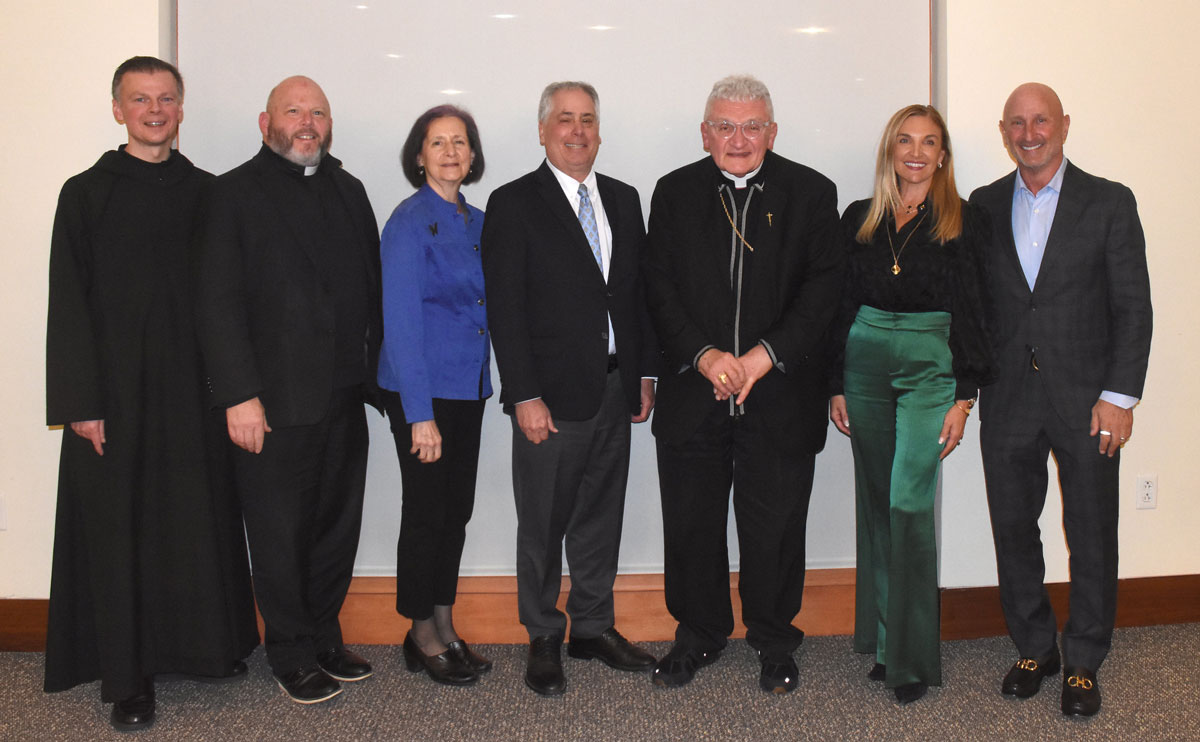
A full house gathered for “An Evening of Dialogue and Unity: Honoring the 60th Anniversary of Nostra Aetate” at the Fred Rogers Center at Saint Vincent on October 28. The event was sponsored by The Rabbi Jason Z. Edelstein Endowment for Catholic-Jewish Dialogue at Saint Vincent College and hosted by Fr. Paul Taylor, O.S.B., C'87, S'91, president of Saint Vincent College. The dialogue partners were the Most Rev. David A. Zubik, Bishop emeritus of the Diocese of Pittsburgh and Rabbi James A. Gibson, who is the present holder Rabbi Jason Edelstein Endowed Chair in Catholic-Jewish Dialogue at Saint Vincent College.
In an informal setting intended to promote questions and answers and respectful dialogue, Saint Vincent Seminary Rector Fr. Edward Mazich, O.S.B., S'98, served as moderator. Both the rabbi and the bishop provided some introductory remarks on Catholic-Jewish dialogue. Fr. Edward then asked each of them to respond to a number of questions designed to promote the dialogue. Then the session was opened for questions from faculty members, College students, seminarians and guests.
Bishop Zubik, who was spending his weeklong retreat at Saint Vincent Seminary, quoted from Romans 11:1, “I ask, then, has God rejected his people? Of course not! For I, too, am an Israelite, a descendant of Abraham, of the tribe of Benjamin,” and 11:29, “For the gifts and the call of God are irrevocable.”
“God is demanding we soften our hearts,” he said, “to look in the mirror.”
Nostra Aetate, he added, is “more than just a document to correct nearly two thousand years of misunderstanding” between the Jewish people and Catholics. It is, he said, about making sure what is in the heart is a relationship grounded in God’s virtue of empathy. If God created “us in his image and likeness,” Bishop Zubik said, “every face we are looking at is the face of God. Denying His face in other people denies our face in Him.”
Rabbi Gibson, who was asked to serve at Saint Vincent following the late Rabbi Edelstein’s retirement, said when he first came to the College he asked Fr. Paul Taylor, “What can’t I teach?” The response from Fr. Paul was that the Benedictines believe in free inquiry. During his time here, Rabbi Gibson said, “Everyone at Saint Vincent has made me a teacher. We have come together not to forfeit our position, but to gain understanding.”
The rabbi also pointed to the statement in Nostra Aetate that rejects antisemitism, “… the Church, mindful of the patrimony she shares with the Jews and moved not by political reasons but by the Gospel’s spiritual love, decries hatred, persecutions, displays of anti-Semitism, directed against Jews at any time and by anyone.”
Dialogue between the faiths was important, both speakers concurred, especially in today’s world, a world which “desperately needs empathy and understanding.”
“What statement in Nostra Aetate is most important to you?” Fr. Edward asked.
The bishop said that to him, the document has, after 2,000 years, “caught us up on what God’s love for the Jewish people means. We must treat all of our brothers and sisters as beloved by God.”
To the rabbi, the most crucial element was the statement that “Jews are not responsible for the death of Jesus.” He said he was in Israel at the same time as Pope John Paul II made his now-famous March 2000 visit. Calling the Israeli people a skeptical people, he said that when the Pope put a note of apology into the Western Wall, the hearts of the Israelis melted.
“God’s dream,” Bishop Zubik added, is “for all of us to be with Him at the end, forever.”
He noted that both the Christian and Jewish peoples are the sons and daughters of Abraham, with the rabbi adding that there was “no Jesus at the beginning of creation. There was Adam.”
An important element to consider, Rabbi Gibson said, is that “Judaism does not require anything from Christianity. It is self-sufficient,” the commandments in the Torah providing instruction on what followers should and should not do. God, he said, “loves all of humanity,” and the Torah teaches to “respect all other humans. Jesus and the Torah have parallel missions: God’s will.”
The dialogue moved to the Holocaust, or the “Shoah,” the Hebrew term for the genocide that began in 1933 and precipitated World War II, which began on September 1, 1939. In an effort to illustrate the number of people who were massacred, Rabbi Gibson said it would be comparable to 120 full Acrisure stadiums (in Pittsburgh). “That’s how many Jews died.”
Holocaust deniers make it a challenge to have empathy, he said. He added that next year (2026), the Jewish people worldwide will finally have the same population as they had in 1939. “We have not repopulated ourselves since September 1, 1939. The intent was to wipe out every Jew.”
“There was not a more evil time in the history of creation,” Bishop Zubik said, with the massacre of six million Jews illustrating the “evil we are capable of doing.”
Both speakers noted the heroics of those who showed empathy and bravery in those times, such as the priests and nuns who helped hide Jewish children and Saint Maximilian Kolbe, who was alleged to be antisemitic in his earlier life, and who gave his life in order to save the life of another while confined at the Auschwitz concentration camp.
Tragedies still occur in recent times, such as the Tree of Life synagogue shooting in Pittsburgh, when 11 people were killed and six wounded as they worshipped during Shabbat morning services on October 27, 2018.
Shootings such as this and others, the almost daily violence, “dulls our senses today,” the bishop said. That is why, he added, “we have assemblies like this one.”
He asked the rabbi for his perspective on why these things happen. Rabbi Gibson noted that antisemitism occurs with equality in all elements of society, recalling Holocaust survivor and author Elie Wiesel’s famous statement that the Holocaust was not “man’s inhumanity to man. No! It was man’s inhumanity to Jews!”
Bishop Zubik said he has been to Auschwitz twice as well as the Yad Vashem World Holocaust Remembrance Center in Jerusalem, calling it haunting.
“Judaism holds humanity to a high standard,” Rabbi Gibson said. “Can it be met?”
Moving to the present-day conflict in Gaza and the West Bank, both men spoke of their travels to Israel and the importance of those visits to their respective faiths.
Rabbi Gibson lived there for two years and has visited 35 times, including once on a joint Jewish-Christian trip with Rev. Liddy Barlow, who heads the Christian Associates of Southwest Pennsylvania, and who was in attendance at the Edelstein event. For himself, he said, he feels a deep connection, a spiritual connection to the land.
Bishop Zubik said that to him, he is visiting the roots of Christianity, but it is also a place that marks God’s covenant with the Jewish people. “God called the Jewish people to be His people. God never goes back on His word. No one of us can be judge of whether someone will go to Heaven or not. God is ever-merciful. It is the deepest desire in all to end up with Him forever.”
“I am intoxicated by the breadth of spiritual experiences” of people he encounters, Rabbi Gibson said. He welcomes anyone who wants to share their faith and commitment to tell their stories, no matter what faith or how they live it. But, he said, “to try to convert me is an affront. Allow me the integrity of my own faith.” He added that the faith commitment to come together to dialogue and to pray “gives me great joy.”
Calling his friendship with Rabbi Gibson an important part of his own faith journey, Bishop Zubik noted that “We journey not just as brothers, but as friends. Rabbi Gibson has contributed to the deepening of my own faith. Faith is a gift. Embrace the gift of your own faith. Live it.”