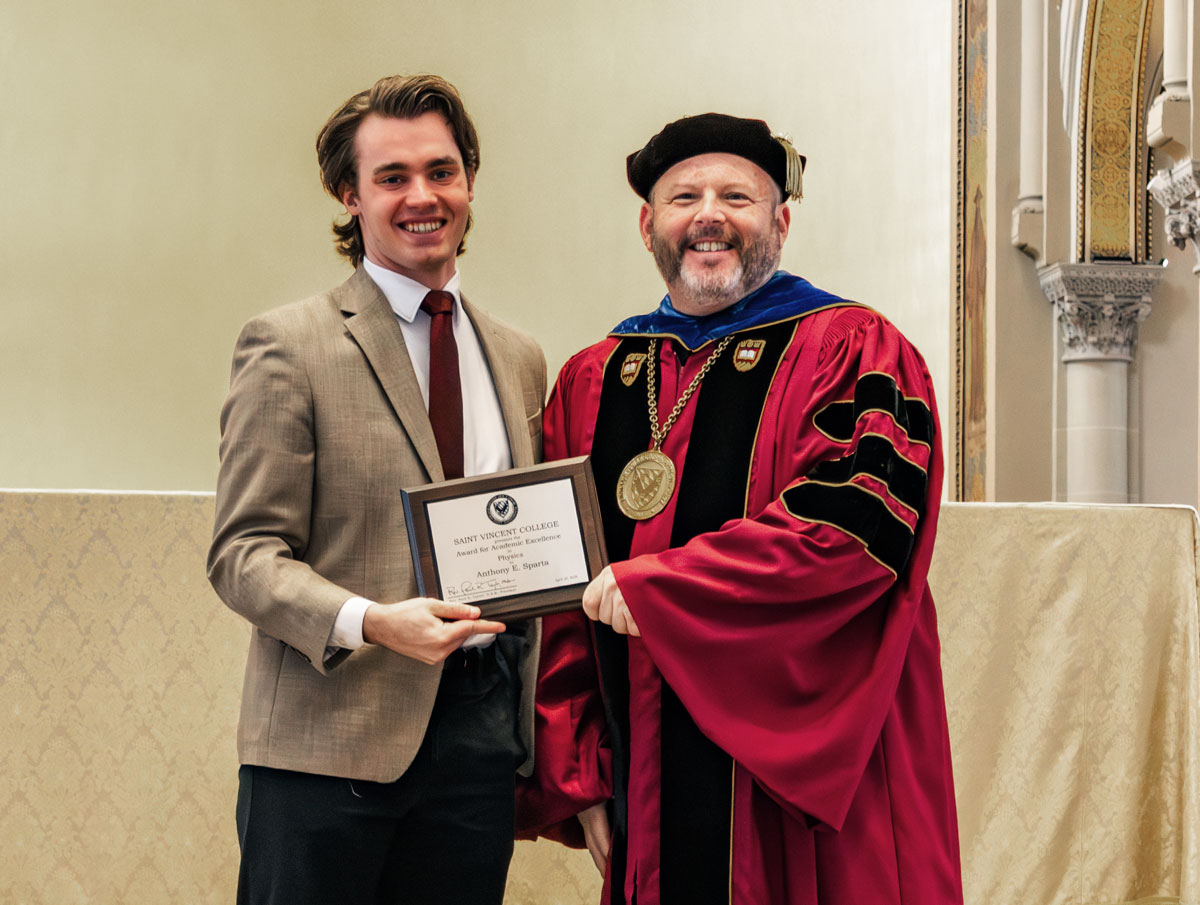
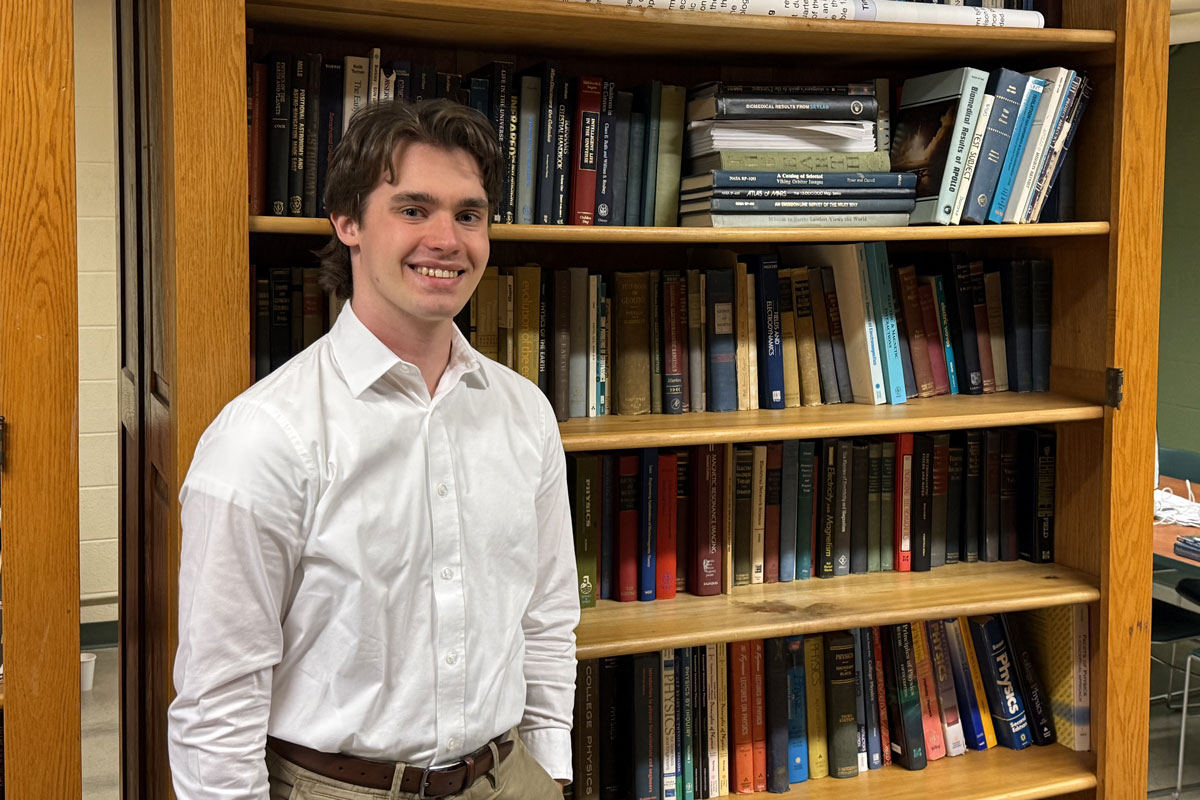
LATROBE, PA – Anthony Sparta, triple majoring in physics, chemistry and mathematics at Saint Vincent College, has performed exceptional research work over the past two years helping to develop catalysts for a magnetic resonance spectroscopy method called Signal Amplification by Reversible Exchange (SABRE).
The 2022 Thomas Jefferson High School graduate and Wimmer Scholar has worked in concert with two Herbert W. Boyer School of Natural Sciences, Mathematics and Computing mainstays on the joint research project: Fr. Michael Antonacci, O.S.B., C’07, S’14, PhD, an associate professor of physics, and Dr. Jason Vohs, a professor of chemistry.
Fr. Michael and Sparta first met when he enrolled in his General Physics II class. He later approached Sparta between his freshman and sophomore years to gauge the student’s interest in doing an internship for a joint research project with Vohs.
The general method that the researchers are working on is nuclear magnetic resonance (NMR), which is at the heart of the clinical imaging technique magnetic resonance imaging (MRI).
“Anyone who’s had an MRI has actually experienced it,” Sparta said, noting that both NMR and MRI use magnetic fields and radio waves to measure nuclear spin. However, conventional NMR suffers from lack of sensitivity and struggles to measure or image molecules at low concentrations in samples or in subjects.
“There are a few ways you usually try to improve NMR signal,” Sparta said. “You can cool things down using liquid nitrogen or liquid helium, which is very expensive, or you build a bigger magnet, which is probably even worse because now you have to redesign your whole system and are working with high-magnetic fields, which have their own problems.”
SABRE is one method of dramatically increasing NMR signal by up to 10,000 times, or in some cases, even 100,000 times, Fr. Michael said.
“What it basically does … you have a molecule that you want to study, and you have a gas called parahydrogen,” Sparta said. “If you mix those on a catalyst, it lets them ‘talk’ to each other and communicates the signal from the parahydrogen over to your molecule, ‘turning up the volume’ whenever you take a signal of it.”
This enhanced visibility enables increased contrast and resolution MRI imaging as well as shorter scan times and lower detection thresholds in NMR spectroscopy.
The work that Fr. Michael and Vohs collaborate on focuses on designing novel SABRE catalysts to meet some of the challenges to translating the SABRE methods from the lab to the clinic. For example, the standard SABRE catalyst—called IMes, for short—can only be dissolved directly into alcohol to perform SABRE, making it difficult to rapidly produce a solution that can be administered to a living subject.
“The idea is if you could get this whole process to be water soluble and work inside a person, then you could make MRI cheaper and more accessible,” Sparta said. “My chemistry side of research was basically trying to find how we can design a catalyst to make it play better with water, while the physics focused on actually testing what we made and then tuning the parameters to optimize the enhancement.”
The real-world implications of the research could potentially involve higher-quality MRI imaging and lower costs while also eliminating the need for large magnets, but as Sparta put it, “we are so far away from that.”
“One area of interest for Dr. Vohs and me is to produce a water-soluble SABRE catalyst that is equally effective as the standard IMes catalyst,” Fr. Michael said. “In fact, Anthony’s work focused on this very area, and he made good progress on a catalyst that we demonstrated could outperform the existing water-soluble catalysts reported in the literature.”
The associate professor of physics added that he was pleased with Sparta’s excellent work, noting that the standout student was interested in NMR hyperpolarization methods and immersed himself in the literature on SABRE catalysts and applications.
“He was also eager to gain independent research experience,” Fr. Michael said, “so he took full advantage of the opportunities and resources we have in the physics and chemistry departments here at Saint Vincent.”
Choosing to enroll at the College truly paid off in dividends for Sparta.
When exploring postsecondary education opportunities while still in high school, he hoped to find an institution deeply rooted in the Catholic faith along with a supportive campus community. As a member of Triumph of the Holy Cross Roman Catholic Parish in Jefferson Hills, Sparta is a lifelong Catholic.
“I realized pretty early on, even in middle school, that having that type of community would be really important,” he said. “My family and I looked at a few places, but Saint Vincent really seemed to be the place that was the best fit.”
Sparta has long had an interest in various academic disciplines. As a middle and high school student, he remembered getting caught up in a wide range of educational content on YouTube, including videos by Numberphile, a channel hosting famous mathematicians covering various topics, and NileRed, a Canadian chemist known for recording videos on interesting chemical reactions and compounds.
“I wanted to be a topologist—a type of mathematician—when I was in seventh grade,” Sparta said. “But I remember thinking that chemistry looked really fun, too, and it would probably be a more secure future. I figured I could enjoy that and thought, okay, I’ll study chemistry. Well, I ended up doing both and then some, so look how that worked out.”
He later added a mathematics major with the thought that he would be developing a solid foundation for chemical theory, in addition to a physics minor. Internship opportunities, however, helped make it possible to add physics as another major, which he declared as his primary major during the springtime of his junior year.
Among his accomplishments are memberships in the College’s chapters of the Sigma Pi Sigma Honor Society for Physics, Gamma Sigma Epsilon Chemistry Honor Society and Pi Mu Epsilon Honorary National Mathematics Society. At the 2026 Spring Honors Convocation, Sparta was presented with the Undergraduate Awards for Academic Excellence in the Major Field of Study for physics and chemistry. The awards recognize graduating students with the highest grade-point average in each program of study.
Having gained a wealth of knowledge in Saint Vincent’s classrooms and laboratories, the Jefferson Hills native said he has often been reminded of the importance of community support. That support has taken on many forms, including membership in Campus Ministry and the College’s Knights of Columbus council, for which Sparta serves as Grand Knight.
He has also had a wide range of professors helping to guide his educational and spiritual journey throughout Saint Vincent College, including Fr. Michael.
“He’s just such a wonderful guy,” Sparta said. “Amazing teacher, amazing person. He’s been such a pleasure to get to work with and learn from.”
Sparta also credits Dr. Daniel Vanden Berk, associate professor in the Department of Physics, and Dr. David W. Grumbine Jr., who serves as Department chair.
In the future, the standout graduating senior hopes to one day teach in a setting similar to Saint Vincent College. He gained valuable experience serving as a teaching assistant for two introductory chemistry labs in addition to the Boyer School’s Collaborative Learning Program.
In the immediate future, however, Sparta was recently accepted to the University of Notre Dame in its physics doctoral program.
“I’ve only been there one time (early March) but just seeing it was such a big part of choosing it,” Sparta said of the campus in Indiana. “There’s a good community around it, and going there, everyone was so nice … the professors were all amazing.
“I'm looking to do theoretical work going forward,” Sparta added. “A little more math-heavy stuff, but I'm pretty open to any field, either in condensed matter like we’ve been doing, nuclear astrophysics or high energy. They have so many great programs there. Who knows, I might even get to do some work with topology.”