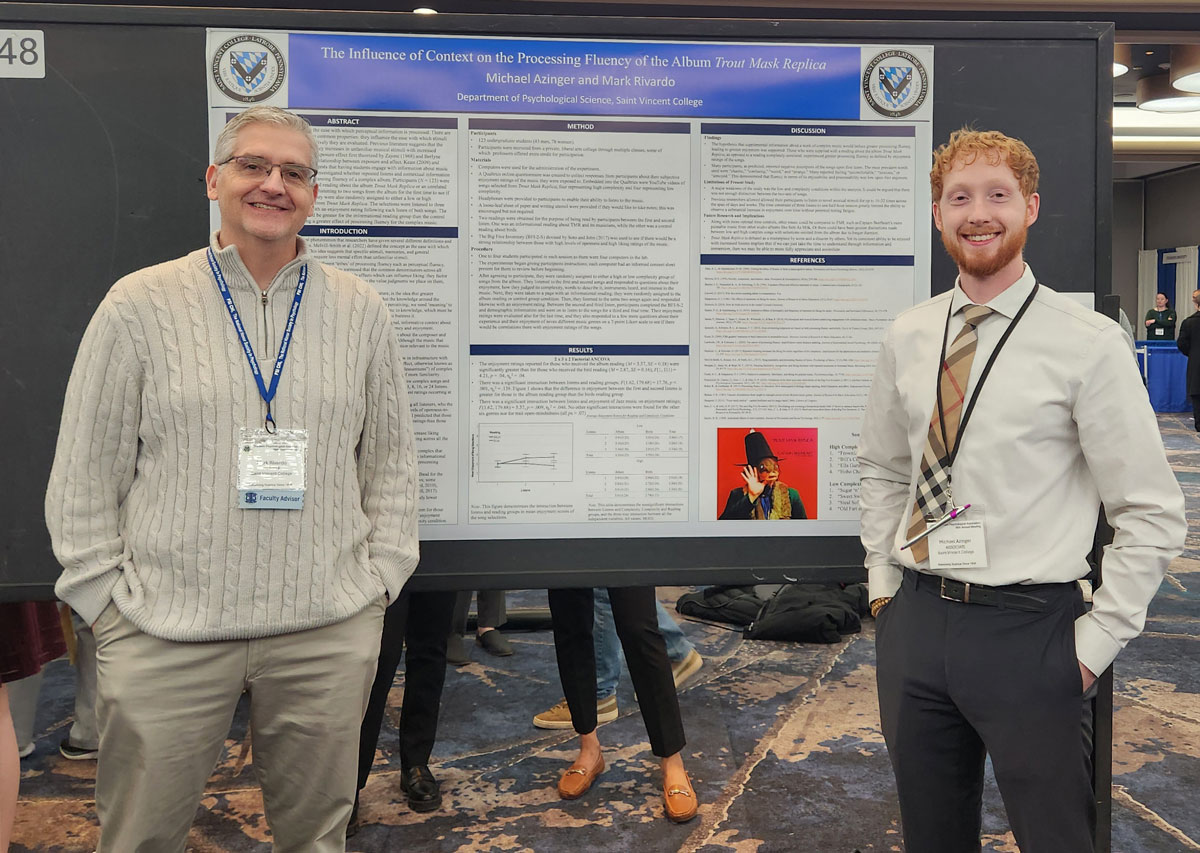
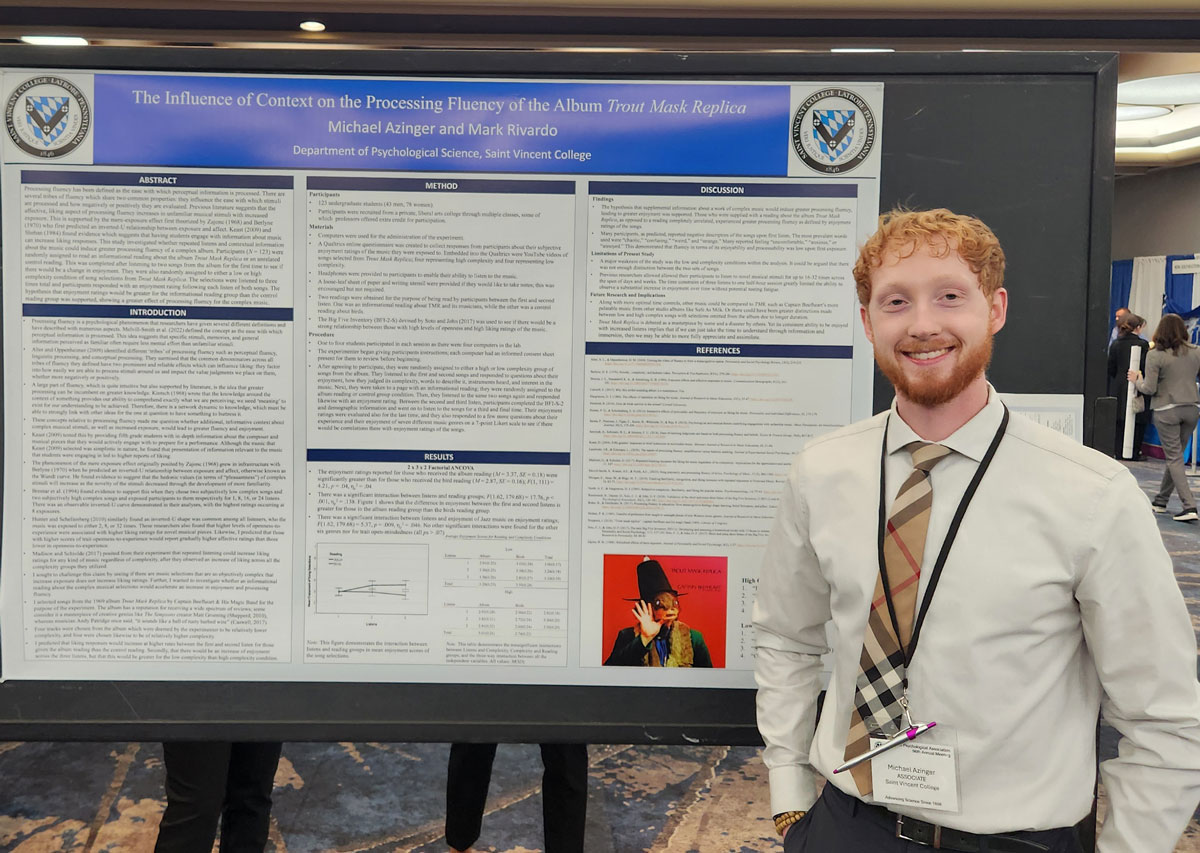
LATROBE, PA – Michael A. Azinger, C’24, and Dr. Mark Rivardo, a professor of psychological science in the School of Arts, Humanities and Social Sciences at Saint Vincent College, recently published a paper in the “North American Journal of Psychology.”
Stemming from Azinger’s senior research thesis, the paper, titled “The Influence of Context on the Processing Fluency of the Album ‘Trout Mask Replica’,” explores the 1969 double album released by Captain Beefheart and His Magic Band, and reputed to be one of the most challenging recordings of the 20th century.
“It’s totally unconventional music,” Azinger said. “The guitarist is playing out of key with the other guitarists, and the drumbeats aren’t really syncopated with the rest of the harmony. The lyrics are absurd and don’t make any sense. It’s just not an ordinary listening experience.”
The curiosity about the record, however, is its reverence in the music industry and history, having been selected for preservation in the United States National Recording Registry by the Library of Congress.
“I was intrigued by it and couldn’t grasp how people could consider this a masterpiece,” Azinger said. “As far as I’m concerned, it’s brutal to even sit down and listen to it.”
In conducting preliminary research about the album itself, Azinger discovered one important commonality amongst listeners: people gain an appreciation for the album after repeated listens.
“I started to experience that myself,” Azinger said. “These guys knew what they were doing, and they had some sort of reason for creating this stuff. The more you learn the history of it, the more interesting it becomes.”
Using processing fluency—the ease with which information is processed by the brain—Azinger’s study investigated whether repeated listens and contextual information about the music could induce greater processing fluency of a complex album.
One hundred twenty-three Saint Vincent undergraduate participants were randomly assigned an informational reading about the album “Trout Mask Replica” or an unrelated control reading about birds. This was completed after listening to two songs from the album for the first time to see if there would be a change in enjoyment. They were also randomly assigned to either a low- or high-complexity condition of song selections from “Trout Mask Replica.” The selections were listened to three times total, and participants responded with an enjoyment rating following each listen of both songs.
The hypothesis that enjoyment ratings would be greater for the informational reading group than the control reading group was supported, showing a greater effect of processing fluency for the complex music.
“I think the main takeaway is that there is something about the album that’s intriguing,” Azinger said, “and I guess the question that remains [is], is the music what people enjoy or is it just the story that intrigues people?
“To me, it demonstrates that the more you’re willing to spend time on something—you get through that frustration and the confusion of what it might be if you don’t understand it at first—the more you can actually appreciate it, assimilate it in your own way, interpret it and then you can enjoy it.”
Azinger and Rivardo presented the research at the 96th annual meeting of the Eastern Psychological Association in New York City in March 2025.
“Mike’s presentation of his work was very well received,” Rivardo said. “He did an excellent job explaining his project to attendees regardless of their backgrounds.”
At that point, the research had not yet been adapted into scholarly work, but through consultation, they decided it was potentially worthy of publication.
“I couldn’t have done any of this without [Rivardo], and he’s the backbone of this entire thing,” Azinger said. “I came up with the idea but he’s the one who got all the statistical stuff in order and made sure everything was correctly formatted.”
After fine-tuning the work during summer 2025, the paper was submitted to the “North American Journal of Psychology” and was accepted for publication in January 2026. It was published in the journal in March 2026.
Having undergraduate work appear in a peer-reviewed scholarly publication is unusual, Rivardo noted. The submissions are reviewed blindly, so the reviewers did not know that the work was conducted by an undergraduate.
“The fact that it was chosen for publication while competing with faculty and graduate-level submissions is validation of the rigor of Mike’s work,” Rivardo said. “It is uncommon for an undergraduate to get their thesis published in a scientific journal, especially one that is not specifically an undergraduate journal. Students at larger institutions might be last in a long list of authors or just get an acknowledgment on a publication, but we are invested in giving highly skilled and motivated students the opportunity to make their own marks on the field.”
After receiving a Bachelor of Science in psychological science during the 20th annual Winter Commencement in December 2024 at Saint Vincent, Azinger relocated to Steubenville, Ohio, to begin a master’s program for clinical mental health counseling in August 2025 at Franciscan University. The Pittsburgh native is projected to graduate in spring 2027.
“The contrast between Mike’s thesis project and his chosen path in mental health counseling may seem to be unusual, but it demonstrates the breadth of his interests and his ability to find connections between them,” Rivardo said. “Mike recognized how cognitive psychology theory could be applied to understand the reactions that listeners have to this complex album. He’s a great representative for the College.”