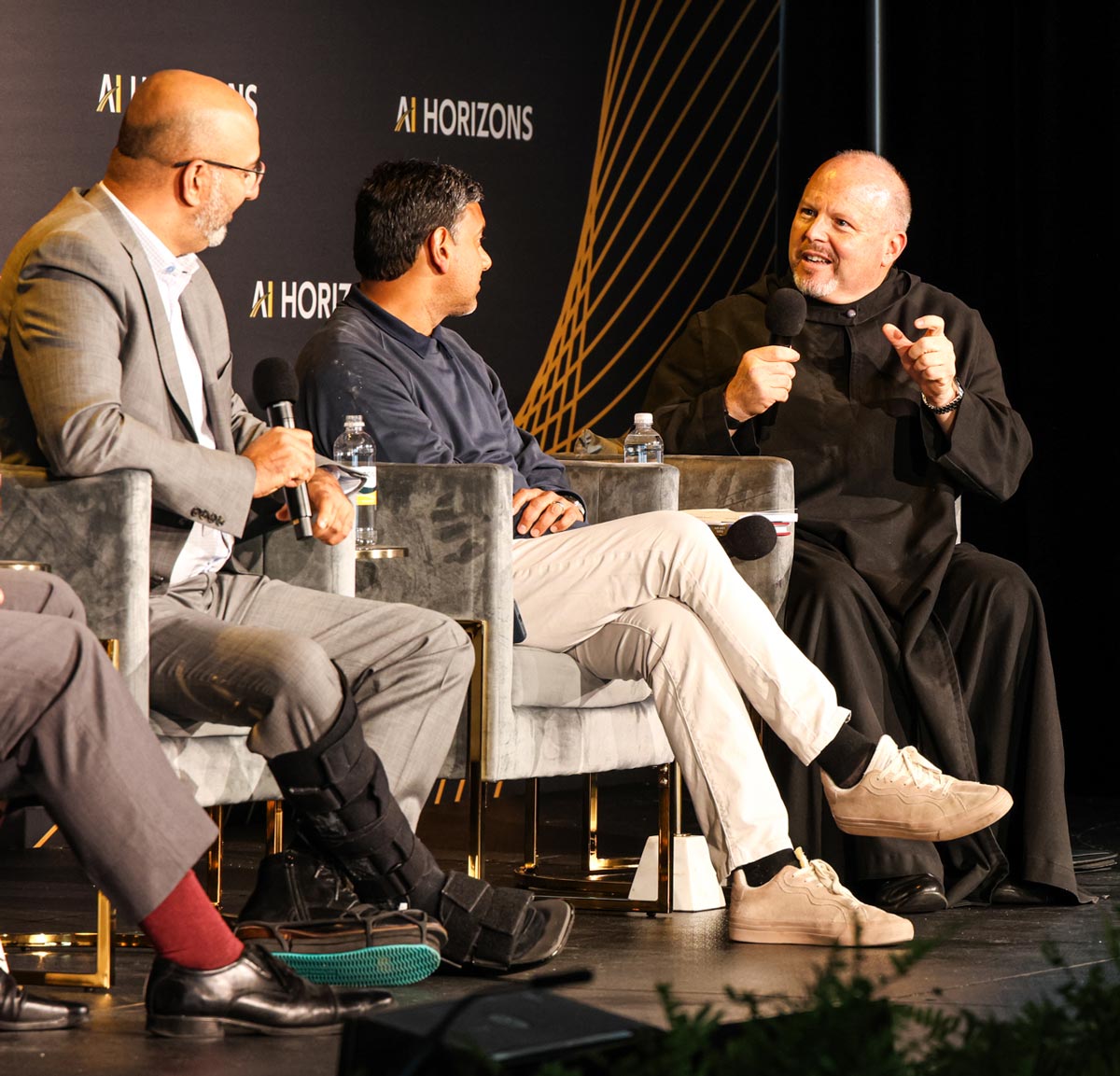
LATROBE, PA – Father Paul Taylor, O.S.B., C’87, S’91, PhD, president of Saint Vincent College, was an invited panelist for the final plenary panel of the AI Horizons Summit in Pittsburgh on Friday, Sept. 18: Can we teach AI wisdom?
The conversation examined the difference between intelligence and wisdom, the role of human judgment, and how we can embrace the potential of AI while safeguarding human dignity and sanctity of the human person.
During the panel discussion, which was covered by the Pittsburgh Business Times among others, Father Paul drew inspiration from Pope Leo XIV’s encyclical, “Magnifica Humanitas,” in which the Holy Father expresses concern about society’s most vulnerable population and safeguarding the human person in the age of artificial intelligence.
“AI is making decisions with all this wonderful information and broad global decisions—are the voices of these wholly human people—the hungry, the homeless and the helpless—are they being considered? How do we consider them, or are those decisions not even being considered?” Father Paul said. “I’m grateful to Pope Leo for being bold enough to raise those kinds of questions and to put them forward. I think my concern is for each human person … how we are affected positively or negatively, but most of all for the most vulnerable without a voice.”
In discussing wisdom, Father Paul recalled the biblical story of King Solomon and two mothers who each had a baby. After one infant died during the night, both mothers claimed the surviving baby. When Solomon called for a sword and threatened to split the baby in half, the first woman did not protest, while the second begged the king to spare the baby’s life and give him to the first woman. Solomon knew the second woman was the true mother because she chose to save her child rather than see him split in half.
“(Solomon) was wise because he had skin in the game, he himself knew the love of his mother, Bathsheba, and because he knew how powerful a mother’s love was, he knew the importance of this decision and how to get at the truth,” Father Paul said. “Wisdom is seeking the truth, and it takes a while to get there, but the way to get there is when we have skin in the game. I think that AI will be able to do a lot of things for us, but it will never have skin in the game.”
In higher education, AI tools present a unique set of opportunities and challenges. While those tools can generate answers to questions with impressive speed, deep learning requires time, effort and struggle.
“I think that when students do not engage in exercising their brain and engage in other ways to write papers, then they have a quick way to the credentials, to the diploma, to the degree, but I don’t know if they’ve learned what they needed to learn,” Father Paul said during the panel discussion. “Are we prioritizing in our education system getting a piece of paper or actually building your mind and your soul and your heart to be that full, human person that you can be? I think humanity defaults to the shortcut, and maybe it’s a negative perspective, and society plays into that.”
Saint Vincent has been at the forefront of the ongoing AI in education debate. Earlier this year, the College announced the appointment of five AI Literacy Integration Fellows from disciplines within the institution’s School of Arts, Humanities and Social Sciences. The Fellows are studying approaches to help students learn about and engage AI tools through an ethical lens centered on human dignity and the common good. A prime goal is to develop teaching strategies that promote AI literacy while ensuring the integrity of students’ learning in their disciplines.
On a global scale, governments are weighing implementation of various frameworks to regulate AI, balancing safety risks against the threat of repressing technological innovation. While the panelists discussed the possibility of businesses and higher education institutions banning AI use, Father Paul tapped into the forbidden fruit metaphor, noting that many would then still use it simply because it’s illegal.
“As soon as it’s forbidden fruit, you’re going to go after it,” he said. “I don’t think an extreme all-in or all-out is right, but AI is a wonderful tool, and it’s here. But how do we engage with it ethically, morally, appropriately while we’re still building the muscles of our brain? That’s where we need to land.”
The event was moderated by Dr. John P. Slattery, executive director of the Carl G. Grefenstette Center for Ethics in Science, Technology and Law at Duquesne University. The panel also featured Gaurab Bansal, executive director of Responsible Innovation Labs, a San Francisco-based nonprofit that aims to guide tech entrepreneurs, and Yaser Sheikh, CEO of Pittsburgh-based AI startup Sooth Labs and the former director of Meta’s Reality Labs.