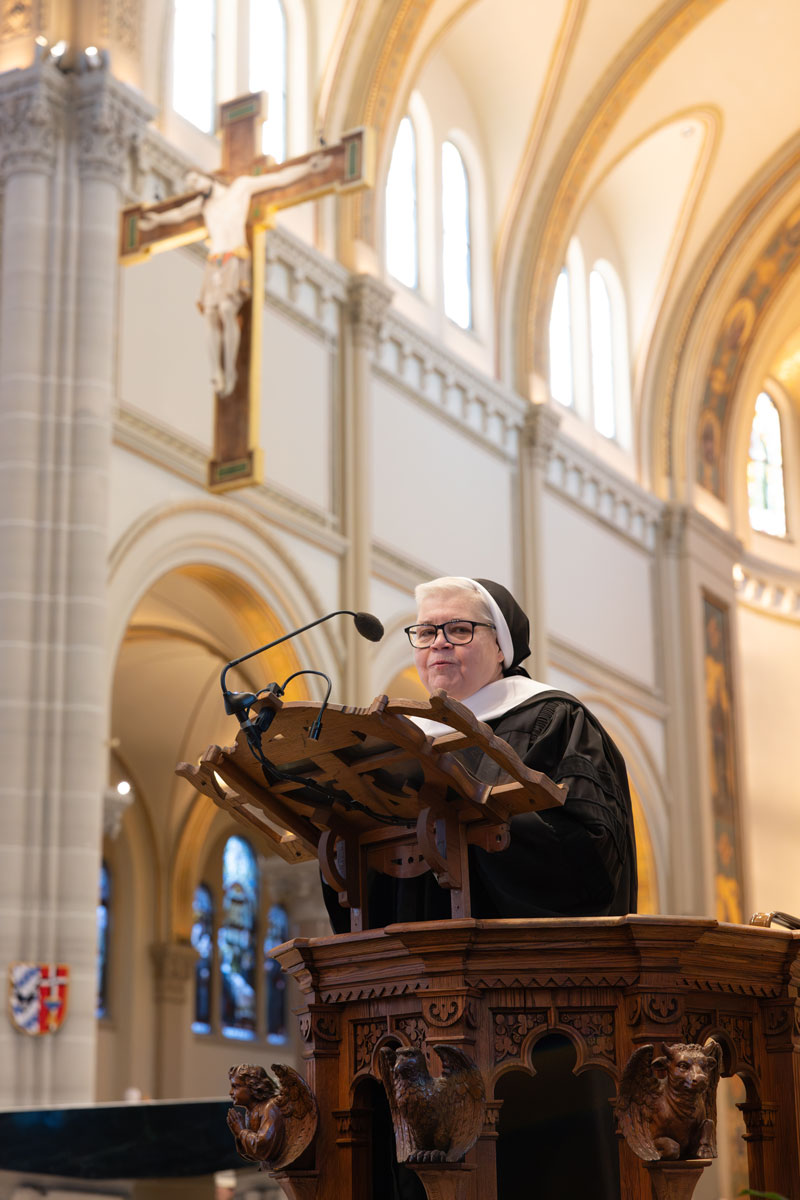
LATROBE, PA – Sister Mary Grace Walsh, ASCJ, PhD, superintendent of schools and secretary for education and faith formation for the Archdiocese of New York, delivered the Founders’ Day reflection during the 2026 Fall Honors Convocation on Thursday, Nov. 19, in the Saint Vincent Archabbey Basilica.
The following is Sr. Mary Grace’s Founders’ Day reflection in its entirety:
“Thank you, Archabbot Martin, Father Paul and the Saint Vincent community for this special honor. Please don’t tell the Dominicans or Jesuits who sponsor the college and universities where I studied, but having an honorary degree from a Benedictine college, especially Saint Vincent College, which is so dear to me, fills me with singular joy. I am most grateful.
“You may wonder what a religious sister whose ministry office is located on Madison Avenue and 51st Street in the heart of New York City, somewhat the antithesis of Latrobe, might have to offer you on this Founders’ Day. I wondered the same thing. As I prepared to politely decline the offer when Father Paul called me, I suddenly remembered how many pictures are on my phone of this beautiful campus and Basilica and the statue of Archabbot Boniface Wimmer outside the entrance. Since that phone call, I counted 34 pictures of the statue and one framed print of him, which is located somewhere in this complex. What has intrigued about that statue? It is not the statue itself but rather the outstretched hand of your founder that for me speaks volumes about his hope, his tenacity, his vision. Beyond the pictures, I knew only that Wimmer came from Bavaria and his mission at Saint Vincent was the beginning of a remarkable period of growth for the Benedictine movement throughout our country. I also knew a portion of his well-known quote: ‘Forward, always forward.’ I have learned a great deal more in recent months.
“I first learned of Saint Vincent College from the best professor I ever had, a Benedictine monk who graduated from Saint Vincent College and through a complicated path found himself in the monastic community in St. Meinrad in Indiana and eventually serving as its archabbot. The first description I heard about Saint Vincent was that it was a bucolic campus amid God’s country. I remember hearing about the beauty of surrounding hills and fields (although he said, ‘heels and fillds’). As a native New Englander, it was truly difficult to imagine. A few years later when I first visited this campus, I understood. And in the many times and seasons of the year and of my life when I have returned here, I have come to understand that the heart of Saint Vincent is more than the natural beauty that surrounds us and the beautiful campus built by human hands thanks to the sacrifice of monks and benefactors, but it all flows back to divine mission of Boniface Wimmer and his 18 companions, and the archabbots and monks and eventually lay leaders who have continued his legacy through their own founding and re-founding of this special place.
“As an Apostle of the Sacred Heart of Jesus, our sisters have had a special connection with Saint Vincent College and the monastic community for decades. I am grateful that the sisters from Clelian Heights were invited to join us today.
“I imagine some of you may know how special Fr. Anthony (Grossi) is to our sisters. I first met Fr. Anthony when he was a rising eighth grader at Butler Catholic School and I was sent there on mission. Stories from those years would probably not be fitting for this occasion! I must say, though, that he was very responsive when I asked if he could send me a booklet on Boniface Wimmer. Shortly after that conversation, two boxes were delivered to my office with four very large volumes of information. I finished the fourth book just last week.
“Reading the letters of the founding archabbot, the history of the College, Seminary and monastic community was truly fascinating. It is a testimony to faith and response to God’s call generation after generation here at Saint Vincent for 180 years. Long after Boniface Wimmer went to his eternal reward, the well-documented fire of 1963 illustrated the ability of this community to literally ‘rise from the ashes.’ And on countless other occasions—through world wars, civil strife, changing cultures, financial challenges and changes in monastic life and the Church—this community has continued to be a light in the darkness, a safe refuge from the storms and a place which many consider home.
“Founders’ Day is an occasion to look backward with gratitude, to recognize the blessings of the present, and, perhaps most importantly, to look forward with faith and hope.
“And there could be no more fitting guide for this reflection than the founder himself, whose famous exhortation continues to inspire us:
“‘Forward, always forward, everywhere forward!’
“These words express far more than determination or ambition. They reveal a profound confidence in Divine Providence and an unwavering conviction that, with God’s grace, even the greatest obstacles can become opportunities.
“In 1846, Boniface Wimmer arrived in the United States with 18 companions and an extraordinary vision: to establish a Benedictine monastery in a new land. When they arrived in New York, the priest who was supposed to meet them did not show up for three days. When he did arrive, they began the long trek to western Pennsylvania by train, boat and foot. They did not know the language and the journey was not easy. Yet once he was appointed pastor of Saint Vincent Parish, he began building a community dedicated to serving God, educating young people and responding to the needs of the Church.
“Those early monks were not strangers to hardship or hard work.
“The College website tells us they milled flour, brewed beer, mined coal, cultivated the land, constructed buildings and instructed students. Their lives embodied the Benedictine understanding that prayer and work are complementary paths to holiness.
“On Nov. 20, 1846, inspired by the Benedictine commitment to the pursuit of truth and knowledge, Wimmer founded Saint Vincent College. What began with 19 men would become the foundation of an extraordinary Benedictine legacy in America. During the remaining years of his life, Wimmer established seven Benedictine abbeys, 152 Benedictine parishes and 75 Benedictine schools. Yet these remarkable numbers tell only part of the story.
“The true measure of his legacy is found in the countless lives transformed through faith, education, pastoral care and service.
“Wimmer understood that the work of God requires both steadfast faith and courageous action. He was not deterred by limited resources, unexpected obstacles or uncertainty about the future.
“He believed that God’s grace could accomplish far more than human calculation might suggest.
“‘Forward, always forward, everywhere forward!’
“There is a beautiful parallel between Wimmer’s exhortation and the life of St. Pier Giorgio Frassati, canonized by Pope Leo XIV on Sept. 7, 2025.
“In his apostolic exhortation Christus Vivit, Pope Francis included Pier Giorgio among the exemplary young witnesses to holiness whom he offered as models for young people throughout the world. Pier Giorgio’s life was marked by deep faith, joyful friendship, a love of adventure and extraordinary generosity toward the poor. I encourage the students present to look to his example.
“An enthusiastic mountain climber, he embraced the motto Verso l’alto—To the heights.
“For Pier Giorgio, who died at the age of 24, these words expressed far more than a passion for climbing mountains. They captured his understanding of the Christian life: a continual striving toward God, a willingness to reach beyond oneself and a determination to place one’s gifts at the service of others.
“We might express this same aspiration in a single Latin word:
“Excelsior—ever higher!
“This is the motto of Sacred Heart Academy in Connecticut, my alma mater, a high school for young women owned by my religious institute. It is also the motto of the state of New York. I can speak to the way ‘excelsior’ continues to inspire generations of Sacred Heart Academy students and alumnae. I am not as certain about how it motivates New Yorkers. I do read it often on license plates as I sit in hours of traffic.
“Verso l’alto. Excelsior. Forward, always forward.
“Three expressions conveying a common spiritual truth: the Christian life is a journey of continual growth, sustained by grace and directed toward God.
“Yet neither Boniface Wimmer nor Pier Giorgio Frassati understood greatness merely in worldly terms.
“For Wimmer, moving forward meant establishing communities of faith, educating generations of young people and bringing the Benedictine tradition to a new land.
“For Pier Giorgio, reaching the heights meant descending into the streets of Turin to serve the poor, comfort the suffering and recognize Christ in those whom society so often overlooked.
“Both remind us that the true measure of our ascent is not how high we rise above others, but how generously we lift others along the way.
“This is also the enduring promise of Catholic education, and particularly of the Benedictine educational tradition. There is no doubt in my mind that a small Catholic liberal arts college can lead the way.
“Saint Vincent seeks not simply to impart knowledge, but to cultivate wisdom; not merely to prepare students for successful careers, but to form men and women of character, faith, compassion and service.
“Here, students are prepared not simply to make a living, but to make a life worthy of the gifts God has entrusted to them.
“Just a few weeks ago, on Oct. 22, Pope Leo XIV offered a beautiful reminder of what lies at the heart of this educational mission.
“Addressing those engaged in the pastoral care of Catholic schools and universities, the Holy Father emphasized that these institutions must be, first and foremost, a home—a place where young people experience the warmth of genuine Christian community.
“He spoke of educators who look a student in the eye, remember a name, notice an absence and rejoice at a return.
“What a beautiful description of the vocation of a Catholic college!
“And what a particularly fitting expression of the Benedictine ideal of hospitality that has animated Saint Vincent since its founding.
“For the ‘Rule of Saint Benedict’ reminds us that all guests are to be received as Christ.
“Hospitality, then, is not simply a courtesy or an institutional virtue. It is a profoundly spiritual act—an encounter with Christ in the person before us.
“Perhaps one of the greatest gifts we can offer another student or a colleague is the assurance that he or she is known, valued and loved.
“This is how Catholic education becomes more than an academic enterprise. It becomes a ministry of presence, a school of charity, and a home in which faith and learning flourish together.
“The themes we have been considering also invite us to reflect on our shared responsibility for the common good. Pope Leo’s first encyclical Magnifica Humanitas, published earlier this year, is a call to safeguard the human person in the time of artificial intelligence.
“He writes that none of us is too insignificant to make a difference. Each of us has opportunities, through our daily choices, to help build a civilization of love.
“We do so by choosing words that foster peace rather than division, pursuing justice, attending to those who suffer, cultivating hope and renewing our commitment to dialogue and cooperation.
“How beautifully these principles reflect the Benedictine tradition!
“And how closely they resemble the example of Pier Giorgio Frassati, who understood that even the simplest acts of friendship, generosity and service could become extraordinary expressions of Christian love.
“Pope Leo shares another image especially appropriate for our celebration: that of the wise architect, one who builds with hope, wisdom and a commitment to the common good.
“Surely Boniface Wimmer was such an architect!
“With faith as his foundation, education as his mission and trust in Divine Providence as his strength, he built not merely a monastery and a college, but a living legacy that continues to shape lives and serve the Church 180 years later.
“And perhaps that is the invitation of this Founders’ Day.
“We are called to be wise architects of the future, faithful stewards of what has been entrusted to us and courageous builders of what is yet to come.
“The Benedictine tradition reminds us that this great work is accomplished not only through extraordinary achievements, but through the faithful offering of ordinary days.
“Through prayer and work.
“Through hospitality and service.
“Through the pursuit of truth and the cultivation of wisdom.
“Through the patient, sometimes hidden, work of forming minds, strengthening hearts and nurturing souls.
“Founders’ Day, therefore, is not simply a celebration of what Boniface Wimmer accomplished 180 years ago.
“It is a summons to continue his work.
“To embrace his confidence in Providence.
“To share his courage in the face of difficulty.
“To recognize, as he did, that God’s work is never finished and that each generation is called to make its own contribution.
“As we give thanks for the past and look toward the future, may we never be content merely to preserve what has been entrusted to us.
“May we seek always to strengthen it, deepen it and pass it on with even greater vitality to those who will follow.
“Verso l’alto—to the heights!
“Excelsior—ever higher!
“And let us take to heart the full measure of Archabbot Boniface Wimmer’s enduring exhortation:
“‘Forward, always forward, everywhere forward! We cannot be held back by debts, by the difficulties of the times, by unfortunate years. Man’s extremity is God’s opportunity.’
“May those words, born of a profound trust in Divine Providence, continue to inspire the Saint Vincent community as it embraces the opportunities and challenges of the years ahead.
“Amen.”