
Alumni will go on to successful careers as
- Risk management specialists
- Capital markets analysts
- Derivatives operations associates
- Financial analysts
- Financial advisors

Finance is the art and science of managing money. Blended with mathematics, students develop a deeper understanding of financial models which prepares students for a career in financial analysis or further education with a master’s or PhD in finance. By their senior year, students will have a strong grasp of portfolio theory and capital markets built on a solid foundation of the mathematical roots of finance. Geared for students looking for careers in investment, there is also a heavy emphasis on practical preparation—the SIE (Securities Industry Essentials) exam, CFA (Chartered Financial Analyst) exam, CFP (Certified Financial Planner) exam, or even the CAIA (Chartered Alternative Investments Analyst) exam. Rooted in the Benedictine value of stewardship, the program emphasizes responsible financial leadership by preparing students to help individuals, businesses, and communities manage resources wisely and sustainably.

Since 2012, every Saint Vincent College finance major has secured employment in the field of finance upon graduation. This track record reflects the strength of our curriculum, the dedication of our faculty, and the real-world preparation of our students.

The Finance program at Saint Vincent College is a Certified Financial Planning (CFP) Registered Program meaning students may take the CFP exam upon graduation without needing additional courses. We are one of only two schools in Western PA with this distinction. SVC finance students who take the CFP exam have an 83% pass rate versus a national average of 65%.

Saint Vincent finance students consistently outperform national averages on professional certification exams. Both graduating seniors and alumni pass the Chartered Financial Analyst (CFA) and Certified Financial Planner (CFP) exams at significantly higher rates. For example, approximately 80% of our finance seniors who sit for the CFA Level I exam pass—compared to a national average in the mid-30% range.

College Raptor ranks SVC’s computational finance track #1 in Pennsylvania and #15 in the U.S.A. based on the program’s academic rigor.
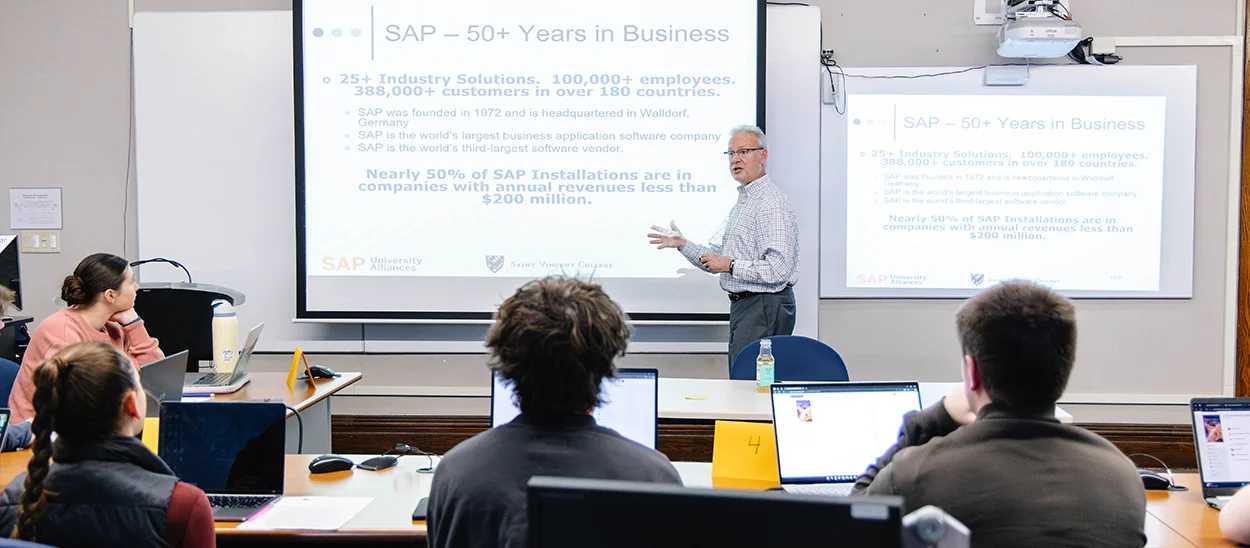
The McKenna School offers SAP Business One Certification. SAP’s comprehensive business software suite is utilized by thousands of prominent world-class companies such as Kennametal Inc., Heinz Corporation, KPMG, Latrobe Specialty Steel Co. and Siemens.
A finance/mathematics degree opens the door to a wide range of career opportunities. Some graduates choose commercial banking, large wealth management firms, and boutique investment shops, while others continue their education with a master’s in finance or a PhD in finance.

Alumni will go on to successful careers as
Our students have secured jobs and internships at a variety of companies in their field such as:

The finance/mathematics major is part of the Alex G. McKenna School of Business, Economics, and Government and supported by our core curriculum, where students delve into diverse academic subjects at both foundational and advanced levels to explore how different disciplines connect, fostering deeper self-understanding and proficiency in their chosen field of study. The mathematics major is blended seamlessly with classes most useful to the field of finance.
50 credits
The program has a strong core that combines courses in investments, financial institutions, international finance, and mathematics.
Investment I: Securities Explore the fundamentals of investing and financial markets in this introductory course. Topics include the time value of money, investment principles, market structures, and techniques for analyzing and valuing bonds and stocks. You'll also learn about interest rates, duration, and both fundamental and technical analysis—building a solid foundation for smart financial decision-making.
Portfolio Theory: Build capital pricing models from their economic underpinnings, with an eye on developing the most effective portfolio for a variety of risk and return profiles. This course also explores theories of market behavior such as the efficient market hypothesis and behavioral finance.
Linear Algebra: Study the core concepts that shape modern mathematics: matrices and linear systems, vector spaces, linear transformations, determinants, inner product spaces, and eigenvalues/eigenvectors. Build a strong foundation for advanced math and applications in finance and data analysis.
Ordinary & Partial Differential Equations: Explore methods for solving first- and second-order differential equations and their applications. Topics include classical and numerical techniques, series solutions, Laplace transforms, higher-order equations, and an introduction to partial differential equations and Fourier series.