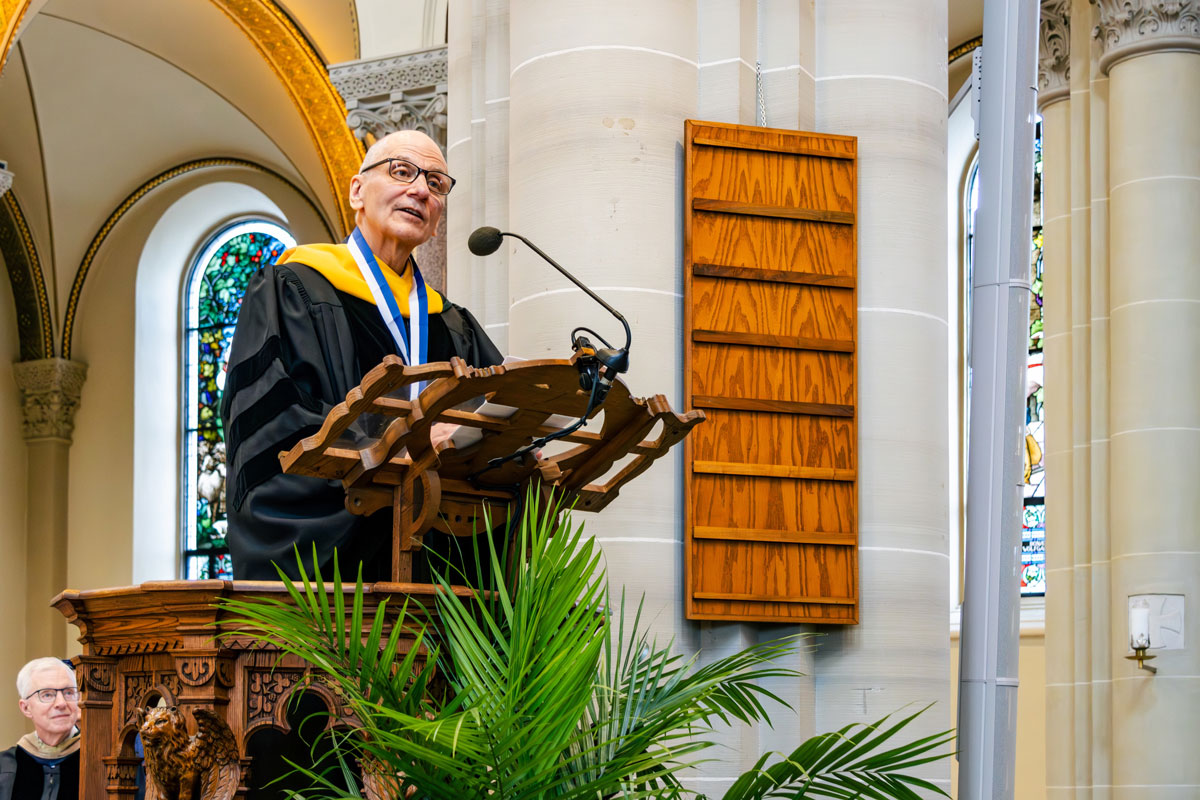
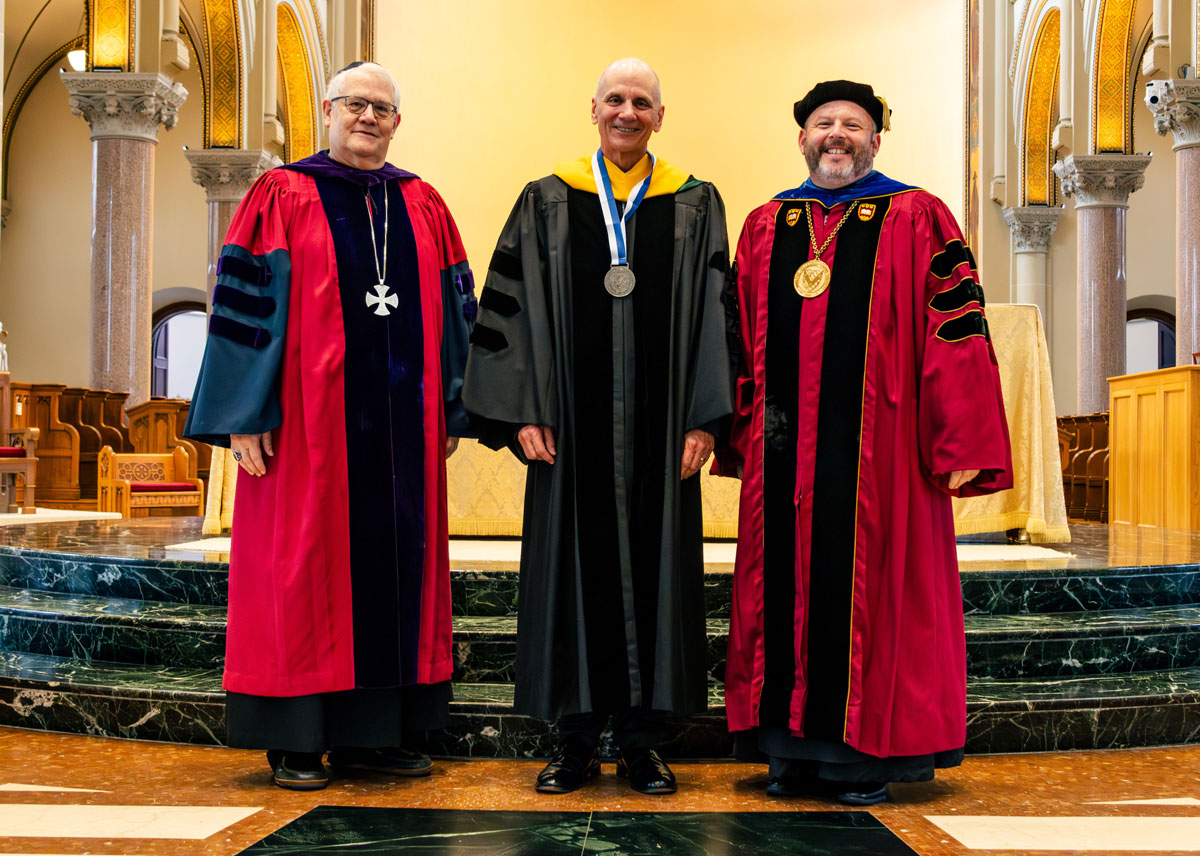
LATROBE, PA – Dr. David A. Dzombak, C’79, Hamerschlag University Professor Emeritus in the Department of Civil and Environmental Engineering at Carnegie Mellon University, was the featured speaker at Saint Vincent College’s 2026 Spring Honors Convocation.
He delivered the following address, titled “In Gratitude for a Liberal Education,” during the event on Wednesday, April 22, in the Saint Vincent Archabbey Basilica:
Thank you, Father Paul and Archabbot Martin, and congratulations to all students and faculty being recognized today.
At the April 1978 Honors Convocation, I received the “Pre-Engineering Award”—we didn’t have an engineering program at the time—and I was among the students recognized. I saved the subsequent issue of the student newspaper “The Review,” which had a story about the Convocation and a photo of the students recognized. I recently pulled out that issue of “The Review,” and looking at the photo and reading the story brought back warm memories of people who influenced my experience at Saint Vincent in important ways, including Mark Rossi, who received the President’s Award and with whom I served on the Saint Vincent Board of Directors; Fr. Campion Gavaler, who was academic dean at the time and a longtime friend of my parents, and others. It also reminded me that for my classmates and me, big hair parted in the middle was the order of the day. As you can see, my hairstyle has changed!
My Saint Vincent experience began at an early age, as my father, William Dzombak, taught chemistry here for 33 years, beginning in 1953. The first time I set foot on campus was not long after I was born in 1957, the second of five children of my mother Agnes and my dad. I have memories of the football stadium where the Boyer School buildings now reside, visiting the operating dairy barn across the street from the Basilica, the big fire of 1963, the effort and enthusiasm of my dad in helping to plan the new science center that was completed in 1969, faculty family picnics at the start of each new academic year, and many others. At the center of all these early memories are the people—various Benedictines and lay faculty and staff—all committed to the mission and community of Saint Vincent.
My father was drawn to Saint Vincent by the liberal arts focus and Catholic framework at the core of the mission and by the opportunity to help grow science education at the College. He had been working at Argonne National Laboratory and regularly attending evening public lectures at the University of Chicago. He met my mother at one of those lectures, by the Catholic philosopher Jacques Maritain. Within a year my father moved to Latrobe to begin his career at Saint Vincent, having been informed about an available position by his former Purdue grad student colleague Fr. Xavier Mihm, a Benedictine. Soon after, he proposed to my mother by telegram. Mom, who grew up on the south side of Chicago, quit her teaching job in the Chicago public school system, paused her master’s studies, got on a train and came to Latrobe, which she had never seen before. Seems a little impulsive! She loved and believed in my father, however, and was in sync with his motivations for coming to Saint Vincent. Like my dad, my mother quickly integrated with the Saint Vincent community, a relationship that meant a lot to both of them for the rest of their lives.
My parents were strong believers in the value of a broad education and the liberal arts. They were both significantly influenced by the intellectual revitalization of liberal education led by President Robert Hutchins and professor of philosophy Mortimer Adler of the University of Chicago in the 1940s. Among other activities, Hutchins and Adler led the development of a compilation of Great Books of the Western World, with background, commentary and comprehensive indexing provided by Hutchins and Adler and various editorial consultants who contributed to the decade-long project. The original 54 volumes of the Great Books series were published by Encyclopedia Brittanica in 1952. The entire series and later additions are on the shelves in the Latimer Library. I encourage you all to stop by the library, take a look at the series and how it’s organized, and pull a book or two on topics that interest you. In the 1960s, the core curriculum at Saint Vincent included a Great Books reading and seminar program that my father helped develop.
The first volume of the Great Books series is an introduction written by Hutchins, titled “The Great Conversation: The Substance of a Liberal Education.” In discussing the purpose of the series in this introduction, Hutchins says the following:
“The aim of liberal education is human excellence, both private and public. ... Its object is the excellence of man as man and man as citizen. It regards man as an end, not as a means; and it regards the ends of life, and not the means to it. For this reason, it is the education of free men. Other types of education or training treat men as means to some other end or are at best concerned with the means of life, with earning a living, and not with its ends.”
Now, getting a job and earning a living are important, and you students are all well prepared to do that, including what you have learned here about the need to be proactive, creative and flexible.
But we live in an age where many view getting a job as the predominant, and for some the only, value of higher education. Many view general education and broad liberal arts study as a waste of time and money.
This is most certainly not the case!
A broad education is critical to leading a meaningful life and a life enriched by a level of understanding of fundamental concepts such as the soul, God, beauty, liberty, human dignity, deep time, evolution and others.
A broad education is also critical to being a good citizen and contributing to quality of life for a community. Saint Vincent alums have a long tradition of accomplishment in this regard.
You students all committed to a broad education when you chose to come to Saint Vincent and its foundation in the liberal arts. As you have experienced, and I am aware from my service on the Board of Directors, Saint Vincent has a unique core curriculum that the faculty works hard to evolve with the times while staying rooted in fundamentals. I expect that each of you already has had opportunity in your time at Saint Vincent to see the benefits of your decision to choose a broad education.
I can assure you that the benefits of your broad education will become even more apparent to you in the years ahead.
I am grateful to my parents and to Saint Vincent for providing me with a broad education that continues to serve me well every day of my life, in all dimensions of my life.
Congratulations again to all students and faculty being recognized today. And thank you for the opportunity to share this joyful day with all of you.