LATROBE, PA – Dr. Lucas Briola, C’13, an associate professor and chair of the Department of Theology housed in Saint Vincent College’s School of Arts, Humanities and Social Sciences, recently released his second book: “Ora et Labora in Our Common Home: A Benedictine Invitation to Care for Creation.”
In his book, Briola explores how the Benedictine way of life can inform and embolden our care for creation. Through a close reading of “The Rule of Saint Benedict,” Briola identifies seven customs and habits characteristic of that life that sustain an integral ecology: listening, stability, humility, hospitality, eating, working and praise.
Seeds for Briola’s new book, published by Liturgical Press on July 28, were initially planted in June 2015 when the late Pope Francis’ second encyclical, Laudato Si’, was released. In the encyclical, Pope Francis discussed the ongoing environmental crisis and urged unified global action.
“I found this to be a very compelling text—I thought there are ways in which Pope Francis’ encyclical and the broader tradition’s call to care for creation has a Benedictine ethos,” Briola said. “You can look at various offhand comments that Saint Pope John Paul II or Pope Benedict XVI made about the environmental crisis and the Church’s response to it. They would often include allusions to this Benedictine tradition and what the Benedictine tradition could offer to our ecological plight.”
Within Laudato Si’ itself is a paragraph on Benedictine monasticism: “We can also look to the great tradition of monasticism. Originally, it was a kind of flight from the world, an escape from the decadence of the cities. The monks sought the desert, convinced that it was the best place for encountering the presence of God. Later, Saint Benedict of Nursia proposed that his monks live in community, combining prayer and spiritual reading with manual labor (ora et labora). Seeing manual labor as spiritually meaningful proved revolutionary. Personal growth and sanctification came to be sought in the interplay of recollection and work. This way of experiencing work makes us more protective and respectful of the environment; it imbues our relationship to the world with a healthy sobriety.”
When Briola first read the paragraph, he believed it could inspire a broader project, which evolved into a new class at the College called Green Discipleship—a Catholic environmental ethics class. Briola sought to structure the course around the Benedictine tradition that he initially encountered as a student at Saint Vincent.
“I designed the course and thought, there aren’t any book sources out there that articulate that Benedictine connection,” Briola said. “Whenever I started piecing things together, I came to see that the course was coming together really well, and I realized that I’d like to share this with others and—in all humility—maybe even help Benedictines themselves realize the profundity of the ‘Rule’ in our contemporary age. Benedictine spirituality, this sense of getting to know one’s place, even one’s ‘common home,’ is something that we can all do, and it’s something that’s increasingly countercultural in our transient age.”
Briola was appointed director of the Center for Catholic Thought and Culture (CCTC), Endowed Chair in Catholic Thought and Culture and a member of the Roundtable of Scholars at the College in April 2026. He started teaching at the College full time in fall 2019.
Briola earned degrees in history and theology from Saint Vincent College. He then earned a Master of Theological Studies in 2015 from the Boston College School of Theology and Ministry and a PhD in systematic theology in 2019 from the Catholic University of America in Washington, DC.
He currently teaches a variety of classes, including Basics of Catholic Faith, first-year Listening Seminar, and upper-level theology courses in addition to Green Discipleship such as Faith and Technology and Gospel of Life/Gospel of Creation. He was presented with the Quentin Schaut Faculty Award in 2024. Briola and his CCTC peers were honored in 2022 with the Projektenmacher Award for their work with the Center.
The theologian has dozens of articles and essays in scholarly and popular publications to his credit. Briola’s essay, “Praise Rather Than Solving Problems: Understanding the Doxological Turn of Laudato Si’ Through Lonergan” (Theological Studies), won the 2021 Award for Best Article of the Year from the College Theology Society.
His first book, “The Eucharistic Vision of Laudato Si’: Praise, Conversion, and Integral Ecology,” was published in 2023 by The Catholic University of America Press.
Briola’s wife, Dr. Catherine Petrany, also teaches theology at Saint Vincent and serves as the Boniface Wimmer Endowed Chair in Monastic Studies. In the role, Petrany is undertaking a major scholarly project: contributing a comprehensive commentary on the Book of Psalms to the Interpretation Commentary Series published by Westminster John Knox Press. This commentary will analyze all 150 psalms through the monastic hermeneutic that has shaped her scholarship, serving as a significant international resource for scholars, clergy and monastic communities.
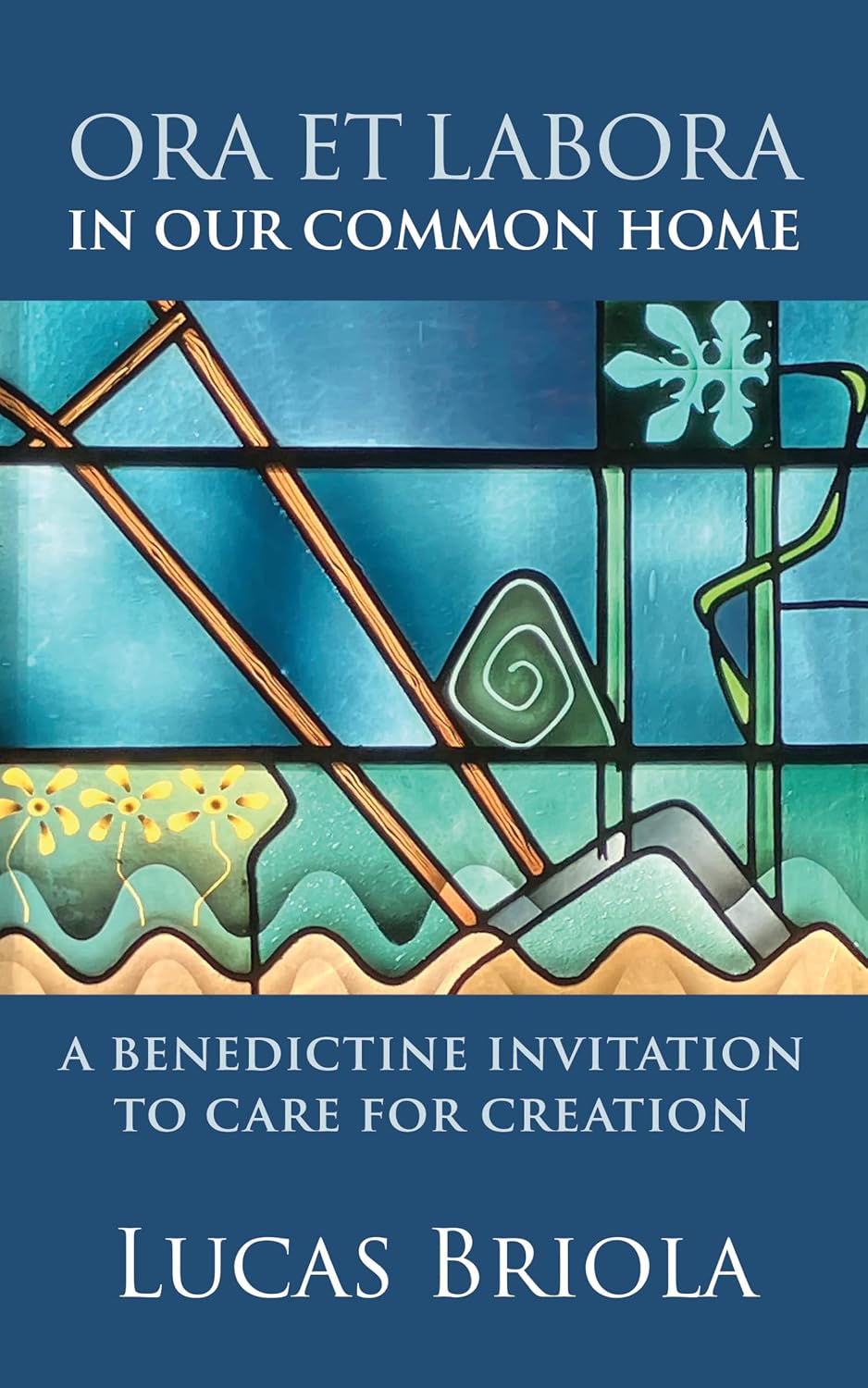
“Ora et Labora in Our Common Home: A Benedictine Invitation to Care for Creation”
