
- Explore the technical foundations of artificial intelligence and the ethical considerations with its development and use.
- Select courses that complement your primary academic discipline and career goals.
- Enhance career opportunities by pairing with a computer science, data science, mathematics, cybersecurity or information systems major.
- Collaborate with students from different majors for a more diverse and innovative learning environment.
- Prepare for graduate studies and lifelong learning in an increasingly AI-driven workforce.
Artificial Intelligence
- Minor
Side Navigation
- Artificial Intelligence
- Business Administration
- Health and Physical Education
- Sports Management
- Accounting
- Addiction Specialist
- Art History
- Biology
- Biochemistry
- Biological Psychology
- Biotechnology
- Business Data Analytics
- Chemistry
- Education: Children's Literature
- Children's Studies
- Communication and Media Studies
- Computer Science
- Creative Writing
- Criminology, Law, and Society
- Cybersecurity
- Data Science
- Digital Art And Media
- Economics
- Education Degrees and Certificates
- Education: Elementary Education PK-6
- Education: Disability Studies - Special Education
- Education: Secondary Grades Education 7-12
- Engineering
- English
- Entrepreneurship
- Environmental Science
- Finance
- Forensic Studies - Financial Investigations
- Forensic Studies - Cybersecurity
- Forensic Studies - Natural Science
- Global Engagement
- Global Security
- Health Science
- History
- Information Systems
- International Business
- International Studies
- Legal Studies
- Liberal Arts
- Management
- Marketing
- Mathematics
- Mathematics/Actuarial Science
- Mathematics and Engineering
- Music Studies
- Management: Operational Excellence
- Peace and Justice Studies
- Philosophy
- Physics
- Political Science
- Psychology
- Public Administration
- Public Health
- Public History
- Public Policy
- Sociology
- Spanish
- Studio Art
- Theology
- The SAP Business One Program
- Explore Undergraduate Degrees
- Undergraduate Programs Schools Index
- Sustainability and Integral Ecology
- Classical Thought
- Sanctity of Life Minor
- Nursing
- Entrepreneurial Success
- Hospitality
- Nonprofit Studies
- Organizational Leadership
- Project Management - Undergraduate
- SAP University Alliance
- Supply Chain
- Aviation Management
- Anthropology
- Data Analytics
- STEM Education
- Legal Practice
- Physics Education
- Education: Psychology Education
- Business Economics
- Mathematics and Economics
- Exercise Science
- Finance and Mathematics
- Public Relations
- Pastoral Ministry
- Integrated Marketing Communication
Learn to lead in an AI-Driven World
Saint Vincent College’s artificial intelligence minor provides students with a technically grounded study of the principles, methods, and technologies underlying modern AI systems. Reaching beyond generative AI usage, this interdisciplinary program will provide the theoretical foundations for AI with curriculum focusing on study across five areas:
- AI foundations
- Data and knowledge engineering
- Machine learning and deep learning
- Design and implementation of AI systems
- Ethical and responsible development and use of AI.
The AI minor is designed primarily to complement technical majors in computing, mathematics, data science, and related disciplines. It emphasizes the foundational knowledge and skills necessary to analyze, develop, implement, and evaluate AI-based solutions. By combining technical skills with ethical reasoning and practical applications, the program equips students to take leadership roles in an increasingly AI-driven world and to help determine the shape of our future.
Explore Undergraduate Degrees
Program Highlights
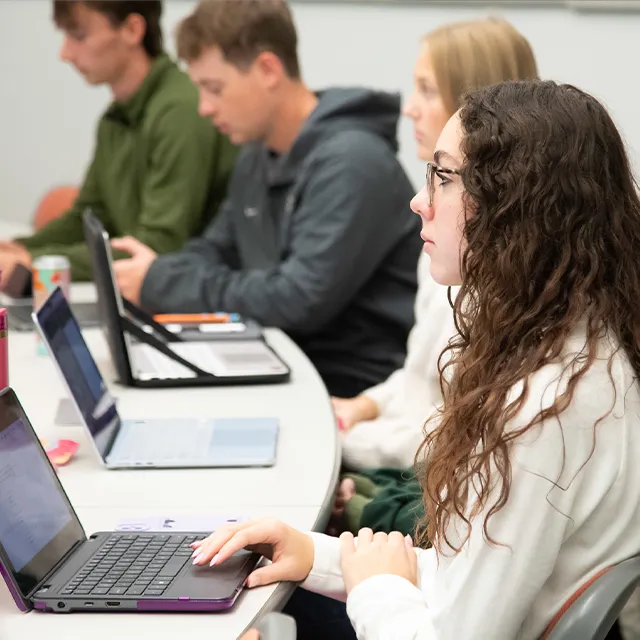
The artificial intelligence minor provides opportunities to:
Faculty Spotlight

Dr. Anthony Serapiglia, chair of the Department of Computing and Information Systems
“Artificial intelligence is a part of nearly all professions today. Our goal is to provide students with a direct technical foundation and practical experience to be able to leverage what AI can do in any environment that they may find themselves in, all the while maintaining the emphasis on human responsibility and ethical considerations that are inherent in everything we do here at Saint Vincent.”

Dr. Mary Regina Boland, assistant professor of data science
“We conducted a survey recently of regional employers to solicit information regarding the desired educational needs of industry. One of the key findings was a desire for more training on Artificial Intelligence. This new minor in artificial intelligence will be perfect for students seeking employment in our region.”
Curriculum Requirements
-
Students will take one course from each of the areas below:
AI Foundations (Reasoning, Heuristic Search, and Knowledge Representation)
- CS-170 – Discrete Structures (3 credits)
- CS-171 – Introduction to Computability (3 credits)
- CS-255 – Intro to Artificial Intelligence (3 credits)
- CS-208 – AI: Models, Methods, and Applications (3 credits)
Data and Knowledge Engineering
- DS-100 – Intro to DS & Analytics (3 credits)
- DS-300 – Methods of DS & Analytics (3 credits)
- CS-350 – Database Concepts/Information Structures (3 credits)
Machine Learning, Including Deep Learning
- CS-345 – Introduction to Machine Learning (3 credits)
- DS-350 – Data Mining (3 credits)
- DS-370 – Deep Learning (3 credits)
- CS-255 – Intro to Artificial Intelligence (3 credits)
- MA-311 – Probability and Statistics I (3 credits)
Design and Implementation of AI Solutions
- CS-255 – Intro to Artificial Intelligence (3 credits)
- DS-370 – Deep Learning (3 credits)
- CS-285 – Applied Programming & Robotics (3 credits)
- MA-341 – Graph Theory (3 credits)
Ethics and Responsible AI
- CS-292 – Engineering and Computer Ethics (3 credits)
AI Elective
- CS-267 – Cloud Foundations (3 credits)
Any course listed above not already used to satisfy one of the preceding categories (3 credits)
-
CS 208 – AI: Models, Methods, and Applications (3 credits)
This course introduces the concepts, capabilities, limitations, and societal implications of modern artificial intelligence, with an emphasis on generative AI. Students will examine contemporary AI models and technologies, including machine learning, neural networks, large language models, recommendation systems, computer vision, generative AI, and autonomous decision-making systems. Designed for students from diverse academic backgrounds, the course focuses on AI literacy, critical evaluation of AI-generated content, and the responsible application of AI technologies rather than advanced model development or programming-intensive implementation.
CS 255 – Introduction to Artificial Intelligence (3 credits)
This course will present overviews of the roots of artificial intelligence, predicate calculus, search techniques, knowledge representation and knowledge-based problem-solving. In addition to other assignments, students will be required to complete projects using languages and techniques which will be introduced during the courseCS 292 – Engineering & Computer Ethics (3 credits)
This course provides students with the knowledge to recognize ethical and professional responsibilities in engineering and computing situations. Students will also learn how to make informed judgments and to articulate the impact of engineering and computing solutions when considering the impact of engineering solutions in global, economic, environmental, and societal contexts.